
Listings on niche tax job boards differ in their features, duration, audience, and promotion. Basic listings suit straightforward vacancies; premium and featured options add visibility for roles that need more targeted reach.
This guide explains how listing features differ and how to match an option to your hiring needs, from specialist tax roles to broader searches.
Key Takeaways
- Match a basic, premium, or featured listing to the role’s visibility needs and posting duration.
- Choose job sites based on the tax specialties and seniority levels you need to reach.
- Use promotion selectively, with placement and audience relevance guiding the decision.
- Explore taxjobs.ai’s Standard Job Postings and Featured Hand-picked Roles for tax-specific hiring.
Basic, premium, and featured listing tiers
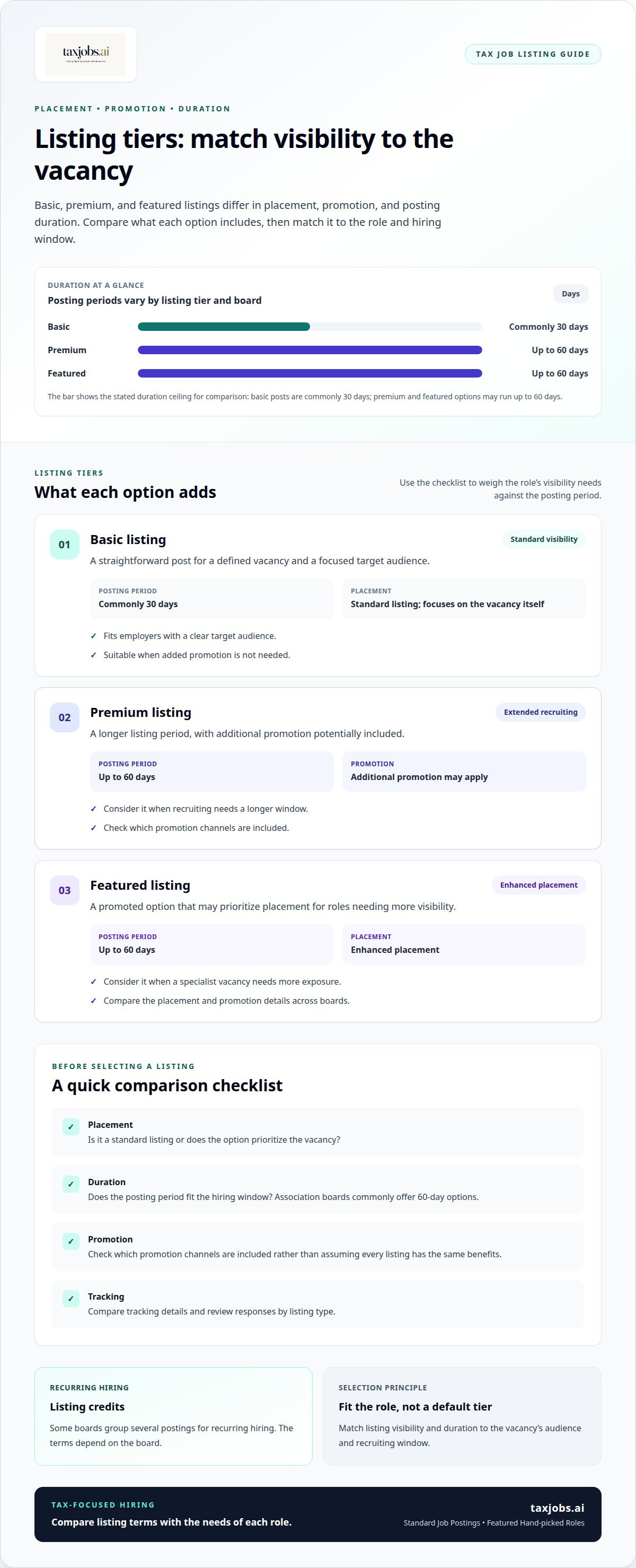
Listing tiers differ by placement, promotion, and duration. A 30-day post suits a defined hiring window; longer options can keep a vacancy visible for extended recruiting.
Some boards may offer listings with different features. Compare placement, duration, and tracking to understand what each listing includes.
Basic Listing Features
A basic listing provides standard visibility for a set period, commonly 30 days. It suits employers with a clear target audience and no need for added promotion. Compared with premium or featured options, it prioritizes the vacancy itself rather than extra placement or promotional exposure.
For nonprofit and government roles, compare eligibility requirements with listings that have the same duration and placement. This helps distinguish a basic listing from a promoted one and assess the terms fairly.
Premium and Featured Features
Premium and featured listings add visibility beyond a standard post. A featured option may prioritize placement, while premium packages can combine promotion with a longer listing period. Association boards commonly offer 60-day options, giving employers more time to reach candidates than a 30-day post.
Promotion matters most when a specialist vacancy needs more exposure. Compare what each tier adds, such as placement, promotion channels, and duration, rather than assuming every listing offers the same benefits.
| Option | Typical duration | Placement and promotion | Best fit |
|---|---|---|---|
| Basic | 30 days | Standard listing | Defined vacancy, focused target |
| Premium | Up to 60 days | Additional promotion may apply | Extended recruiting window |
| Featured | Up to 60 days | Enhanced placement | Roles needing more visibility |
| Listing credits | Depends on board | Several postings grouped | Recurring hiring volume |
Some boards group several job postings for recurring hiring. Match the listing to the role’s visibility needs and recruiting window, then track responses by listing type.
Choosing a job site provider for your hiring needs
Start with the vacancy, not a default channel. The tax specialty, seniority, location, and salary shape the candidate audience. A transfer pricing manager needs a different target audience from an entry-level compliance hire. Use that distinction to choose a board and keep the posting strategy focused on the role.
Hiring timelines offer another useful filter. If your process takes 60 or more days, niche boards may add access to candidates already focused on tax careers. General boards may suit employers filling one or two positions annually, especially when hiring takes 30 days or less. You can weigh these conditions against the role’s urgency and recruiting volume.
Before publishing, clarify the job’s scope and candidate requirements. Distinguish, for example, indirect tax experience from broader tax accounting work. Including salary information can help candidates assess whether the role fits their expectations and experience. For recurring annual hiring, consider whether one channel suits related openings or whether each vacancy needs its own placement strategy.
- Define the target: Identify specialty, seniority, location, and required experience.
- Match the channel: Align the board’s audience with the role and hiring timeline.
- Track performance: Review responses and relevant applicants during the 30-day posting period.
Track candidate fit, not just visibility. A high response count does not show whether applicants meet the technical requirements. Review candidate relevance, application flow, and timing, then use those signals to shape the next posting. For specialist roles, this is more useful than relying on impressions alone.
For a tax-focused audience, review tax job listings alongside the role’s requirements. Transfer pricing, VAT/GST, and Pillar Two vacancies call for precise targeting; a general accounting title may not reach the same candidates.
Working with industry-specific job boards
Match each board’s audience to the tax role. A tax preparer vacancy differs from a CPA position focused on corporate reporting. For tax accountant roles, relevant candidates depend on industry, seniority, and technical scope. Use these criteria to find a board focused on specialist careers and define which applicant profiles matter.
For tax preparers, look for audiences interested in preparation work; for CPAs, consider boards serving accounting professionals. Tax accountant searches may call for candidates in corporate tax, compliance, or financial reporting. Compare each audience with broader channels and build a mix around the role’s requirements.
Choose a board based on the job description, not just its title. A VAT/GST role needs a different audience from one focused on transfer pricing or Pillar Two. Separate essential qualifications from preferred experience, then assess whether each board reaches candidates with the relevant background. This helps determine whether a specialist board or broader careers channel better fits the search.
For recurring vacancies, assess whether related roles share a specialty, candidate profile, and hiring workflow. For occasional searches with distinct requirements, make each placement decision separately to keep the campaign focused on its audience and selection criteria.
- Define the role: Separate required credentials from specialty experience.
- Map the audience: Match the vacancy to tax-focused or association boards.
- Compare channels: Assess specialist reach against broader options such as LinkedIn.
- Review results: Track applicant relevance and hiring outcomes.
For example, a CPA opening in corporate tax requires a different candidate profile from a tax preparer role supporting individual returns. Use applicant quality and hiring-team feedback to refine future campaigns. This keeps the strategy specific across specialist boards and broader careers channels.
Choose a board suited to the role: tax preparation audiences for tax preparers, and accounting-professional or association boards for CPAs. For tax accountants, prioritize boards that reach candidates in the relevant specialty, such as corporate tax, compliance, or financial reporting.
Professional job board promotion
Promote a tax vacancy by matching its placement to the intended audience. A Pillar Two role, for example, needs visibility among candidates with relevant international tax experience. State the specialty, seniority, and core responsibilities clearly so targeted promotion has a specific message rather than a generic appeal to tax talent.
Featured placement can combine homepage visibility, search highlighting, and email alerts. These options serve different discovery paths: homepage placement raises prominence, while search highlighting distinguishes the listing among results. Email inclusion can reach candidates who follow board updates. You can select channels based on the role and the audience each channel reaches.
Duration matters too. Homepage featured placements commonly run for 7-14 days. You can align that window with the vacancy’s hiring schedule, then monitor application flow as promotion runs. For a time-sensitive tax technology opening, a concentrated featured period may support early visibility; a longer standard listing can maintain access afterward.
Set clear measures for promotion. Track relevant applicants, interview progression, and source quality, not impressions alone. Review campaigns regularly, recognizing that specialties can attract different candidate responses. If a listing earns clicks but few qualified applications, revisit its title, requirements, or channel mix.
- Sharpen the message: Identify the tax specialty and required experience in the opening section.
- Select placement: Match homepage, search, or email promotion to candidate discovery habits.
- Review results: Track applicant relevance and interview progression by source.
- Refine the campaign: Adjust the listing or promotion channel when responses miss the target.
For a specialist vacancy, align the promotional section with the technical scope. Explore tax job postings to connect your role with a tax-focused audience.
Taxjobs.ai: Standard Job Postings
taxjobs.ai connects employers with tax professionals through Standard Job Postings and a Tax Specialty Job Directory. These options suit vacancies that need a focused audience, such as candidates in transfer pricing, VAT/GST, or tax technology.
The Recruiter Dashboard helps employers manage listings, while Featured Hand-picked Roles offer a way to highlight selected vacancies. Choose the format that fits the hiring need: a standard post for a defined opening, or featured placement when added visibility is useful.
These listings serve employers hiring across seniority levels, from graduate interns to partners, and across Big 4 firms, law firms, and in-house corporate departments. They are job-board tools, not direct headhunting, tax advisory, or resume-writing services.
Post your tax vacancy on taxjobs.ai to reach a focused audience of tax professionals.
Set the next hiring campaign in motion
Turn your hiring priorities into a clear job brief. Define the role’s technical scope, seniority, location, and the candidate experience that matters most. These details give your team a practical basis for assessing whether the campaign is reaching the right professionals.
Once applications arrive, review candidate fit with the hiring team and note where the strongest profiles came from. Use that feedback to sharpen the next role description and channel strategy. taxjobs.ai focuses on tax-specific opportunities, making it a relevant platform for employers seeking a specialist audience.
Contact taxjobs.ai about tax hiring to discuss your next role. The team brings tax hiring expertise to the conversation, and a clear brief gives your team a useful starting point to move forward.
Frequently Asked Questions
How do niche job boards support recruiting?
Niche job boards connect employers with candidates focused on a profession or specialty. Their value lies in audience alignment: a tax-focused board helps professionals seeking tax roles find relevant vacancies. Employers can describe technical requirements clearly and reach candidates whose experience matches the opening.
How should you choose an online job board?
Start with the role’s required expertise, seniority, and location. Then assess whether the board’s audience matches those criteria and its listing format supports the information candidates need. For a role requiring tax technology experience, for example, describe the relevant systems and responsibilities instead of relying on a broad accounting title.
What should you prepare before starting a hiring campaign?
Prepare a clear role description that covers reporting structure, core responsibilities, and required qualifications. Separate essential requirements from preferred ones, and align the hiring team on those distinctions before applications arrive. Reviewers will then have a shared framework for assessing candidates and tying interview decisions to the position’s needs.
How can you identify the right board for a tax vacancy?
Match the vacancy’s technical focus to the board’s audience and categories. An indirect tax role, for example, should state its responsibilities and experience requirements directly. Consider whether candidates also need experience in a particular sector or work environment. These details distinguish a specialist search from broader accounting recruitment.
What should employers consider when recruiting tax professionals in the United States?
State the role’s location, work arrangement, seniority, and technical scope. Tax roles span corporate departments, accounting firms, and other employer types, so context helps candidates assess fit. Describe the team’s responsibilities and the position’s expected contribution clearly to support more focused applications and screening.
How should you plan for occasional versus recurring tax hiring?
For an occasional vacancy, shape the campaign around that role’s requirements and candidate profile. Recurring hiring can benefit from consistent role categories and a shared review process, while allowing for differences between openings. For example, set separate criteria for tax compliance and tax technology positions. This makes future searches easier to organize without treating every vacancy alike.