
The broadest job board isn’t always the most direct route to tax candidates. A niche job board for hiring tax professionals can help employers reach specialists, while general boards, accounting-focused sites, professional associations, and employers’ career pages offer other channels.
Tax hiring spans distinct practices and seniority levels, from graduate roles to partner appointments. A channel suited to general accounting vacancies may not reach candidates in transfer pricing, VAT/GST, Pillar Two, or tax technology. Learn where to find accounting and tax candidates, how industry-specific and corporate tax boards differ, and what niche platforms offer compared with general job sites.
This guide breaks down the main types of job boards and the roles each can help you reach. It also explains how to assess a channel against your vacancy’s specialty, seniority, and employer type, so you can choose a practical mix for your hiring needs.
Key Takeaways
- Match the job board to the role’s tax specialty, seniority, and employer type to reach more relevant candidates.
- Industry-focused boards can help surface candidates with sector-specific tax experience; corporate roles may call for a different mix of technical and business skills.
- Use general boards for broad reach and niche boards for focused visibility, then set salary expectations around the role and market context.
- Taxjobs.ai connects AI clients to live tax jobs and knowledge over MCP, with MCP-compatible clients connecting through Streamable HTTP.
Niche job boards for accounting and tax hiring
A niche job board for hiring tax professionals can focus your search on specific practices rather than broad job families. Employers can target corporate tax, indirect tax, transfer pricing, tax technology, or compliance roles with tailored descriptions. That helps distinguish a VAT/GST specialist from a general ledger accountant before applications reach review. Specify seniority, employer type, location, and relevant systems or reporting experience in the posting.
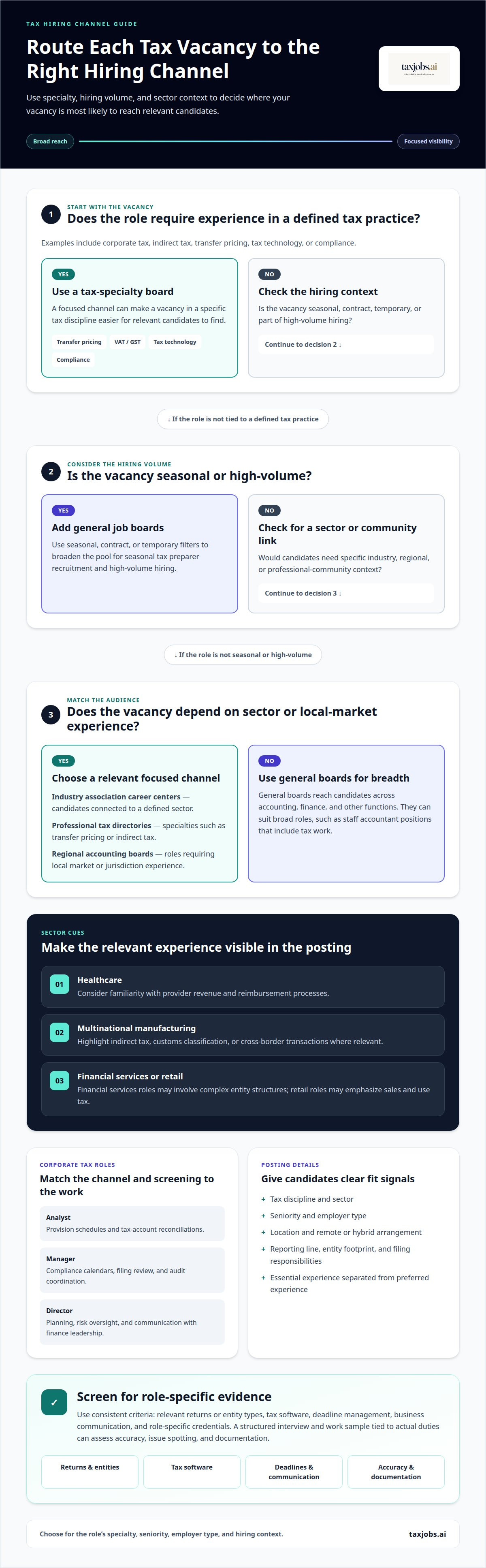
For seasonal tax preparer recruitment, tax-specialty job boards and accounting association career centers offer focused reach. General boards with seasonal, contract, or temporary filters can broaden the pool. Choose channels based on the balance you need between candidate specialization and application volume.
- Tax-specialty boards suit roles requiring experience in a defined tax practice.
- Accounting association career centers reach candidates connected to professional communities.
- General job boards can extend reach for seasonal vacancies and high-volume hiring.
For U.S. recruiting, distinguish employer preferences from credentials required for the role. Requirements depend on the duties and jurisdiction. Identify the applicable state or federal authority, then validate credentials through its official records. Avoid treating one credential as universal across all tax positions.
Screen applicants against consistent criteria: relevant returns or entity types, tax software, deadline management, business communication, and role-specific credentials. Use a structured interview and a work sample tied to the actual duties. Assess accuracy, issue spotting, and documentation, not just general accounting experience.
Specialized job boards by industry
Industry-specific boards can help employers find tax candidates familiar with a sector’s operating model. A healthcare organization may need professionals who understand provider revenue and reimbursement processes. A multinational manufacturer may prioritize indirect tax, customs classification, or cross-border transactions. Sector context matters because tax work depends on transaction types, systems, reporting cycles, and internal stakeholders. A niche job board for hiring tax professionals can make this experience easier to target in a vacancy.
To target a vacancy by location or specialty, choose a board with relevant filters or categories. State the work location, remote or hybrid arrangement, tax discipline, and sector in the posting. For example, label a remote VAT role by region and industry rather than relying on a generic “tax accountant” title. A niche job board for hiring tax professionals can also make specialist categories easier for candidates to find.
- Industry association career centers: useful for reaching candidates connected to a defined sector.
- Professional tax directories: useful for roles in specialties such as transfer pricing or indirect tax.
- Regional accounting boards: useful when the position requires local market or jurisdiction experience.
Match the channel to the role’s actual work. A financial services tax vacancy may require familiarity with complex entity structures, while a retail position may emphasize sales and use tax. Make these requirements explicit in the title and description. Separate essential experience from preferred sector exposure, then screen applications against both. This helps candidates assess fit and recruiters distinguish direct industry experience from transferable tax skills.
Corporate tax jobs
Corporate tax teams hire for distinct responsibilities. A tax analyst may prepare provision schedules and reconcile tax accounts; a manager may oversee compliance calendars, review filings, and coordinate audits. Director roles add planning, risk oversight, and communication with finance leadership. State the role’s scope, reporting line, entity footprint, and responsibility for federal, state, or international tax work in the posting.
Screen for experience that matches the employer’s operating model. A multinational group may need candidates familiar with cross-border entities and tax reporting. A domestic company may prioritize provision work, return preparation, or tax accounting controls. Ask applicants to describe a project involving reconciliations, audit requests, or process improvement. Their examples can reveal ownership and judgment beyond a list of responsibilities.
- SAP or Oracle: useful context for roles that reconcile tax data from enterprise systems.
- Excel: relevant for schedules, reconciliations, and analysis; assess the complexity candidates have handled.
- Tax provision software: relevant when the role prepares or reviews provision calculations and supporting documentation.
Separate required capabilities from preferred experience. For a tax manager, specify review responsibilities, stakeholder coordination, and the types of filings handled. For a tax technology role, emphasize system implementation, data quality, and communication between tax and finance teams. These distinctions help candidates assess fit and give recruiters consistent screening criteria. Describing the actual work also distinguishes corporate tax positions from public accounting roles with different client-service demands.
General job boards versus niche job boards
General boards expose tax vacancies to candidates across accounting, finance, and other functions. That reach can help with broad roles, such as staff accountant positions that include tax work. A niche board concentrates on tax disciplines, making it a more direct channel for roles in corporate tax, transfer pricing, or VAT/GST. The trade-off is breadth versus specialization, not a guaranteed difference in hiring outcomes.
Tax-focused boards generally draw a narrower audience than general platforms, but no single audience-size figure applies across them. Candidate quality depends on fit: relevant tax experience, seniority, location, and the work described. The global market includes more than 50,000 online job boards and 260,000+ recruiting agencies, but those figures do not measure tax-board reach or applicant quality.
- General job boards: useful for broad visibility, entry-level accounting roles, and vacancies combining tax with finance duties.
- Tax specialty directories: useful for reaching candidates by practice area, such as indirect tax or tax technology.
- Applicant tracking systems: useful for organizing applications and comparing candidates against consistent screening criteria.
Use both channels when a vacancy requires specialist expertise and wider exposure. Keep the job title and core requirements consistent, then track relevant applications, interview progression, and qualified hires by source. For example, compare each channel’s performance for a corporate tax analyst opening. Review results by role type, not just total application count. A smaller pool can still be useful if more applicants match the required tax work.
Tax salary insights
Salary information helps you define a credible hiring brief before publication. Compare the role’s level, location, specialty, and scope rather than relying on a broad “tax professional” benchmark. A corporate tax analyst handling provision schedules has a different remit from a director overseeing planning, audits, and finance leadership. Specify whether the position owns compliance, review, or strategy.
Use current postings for comparable roles as one input, then align them with your organization’s internal job levels. Compare location and work model, relevant experience, reporting responsibilities, and specialist knowledge such as transfer pricing or sales and use tax. Focus on duties, not titles alone. Titles vary across employers, even when the underlying work is similar.
- Separate base pay from variable compensation and benefits when describing the total package.
- State how seniority, specialist expertise, and management responsibilities shape the offer.
- Review the salary range when the role’s location or scope changes during recruitment.
Clear compensation information helps candidates assess fit before applying. It also gives recruiters a consistent basis for discussing expectations and evaluating competing offers. For example, a VAT specialist role with regional responsibility should not be benchmarked like a general tax compliance position. Match the posted range to the actual remit, then explain the role’s growth path, reporting structure, and decision-making authority. These details help candidates compare the full opportunity, not just its title.
Taxjobs.ai
taxjobs.ai gives employers a specialist channel for reaching tax candidates across experience levels and practice areas. The platform tracks and curates thousands of live tax career opportunities, including roles in transfer pricing, VAT/GST, Pillar Two, and tax technology. Employers hiring for a defined specialty can use this focus to make relevant vacancies easier for candidates to find.
taxjobs.ai also connects AI clients to live tax jobs and knowledge over MCP. MCP-compatible clients can connect over Streamable HTTP to access tax job and knowledge information through that protocol. This is useful when your organization uses a compatible client and wants access to tax-specific information.
Standard Job Postings let employers publish vacancies on taxjobs.ai. The Recruiter Dashboard supports recruiter workflows, while Featured Hand-picked Roles highlight selected opportunities. The Tax Specialty Job Directory organizes roles around specialist tax areas. Together, these options support different hiring needs, from general tax vacancies to targeted searches for indirect tax or tax technology candidates.
The taxjobs.ai team’s focus on tax-specific roles helps keep the platform organized around specialist hiring needs. For help with tax hiring, contact taxjobs.ai.
Frequently Asked Questions
How can a specialist help you place accounting jobs and reach candidates?
A tax recruitment specialist can translate a vacancy into clear requirements and select channels suited to its role and specialty. A seasonal preparer opening, for example, needs different targeting from a senior corporate tax position. A specialist can also organize applicants against consistent criteria, such as credentials, tax software experience, and return types handled, helping you assess fit without relying on job titles alone.
What niche job boards specialize in hiring tax professionals in the United States?
Taxjobs.ai is a tax-focused option for U.S. employers, with listings organized around categories such as corporate tax, indirect tax, and tax technology. Its location filters include the United States and states such as California, Texas, and New York. Pair a specialty category with a location filter to narrow vacancies for candidates seeking relevant tax work in a defined market.
Which job boards reach CPAs, enrolled agents, tax attorneys, and seasonal tax preparers?
Use tax-focused boards for specialist vacancies, then state the credential or experience sought directly in the posting. A CPA opening should identify the required accounting and tax duties; an enrolled-agent or tax-attorney role should specify the relevant work. For seasonal preparers, include the schedule and expected return types. Professional association career centers can provide another channel for reaching credentialed candidates.
How do tax-specialist job boards compare with LinkedIn, Indeed, and general accounting job boards?
LinkedIn and Indeed can provide broad visibility across professions, while general accounting boards focus more closely on finance and accounting candidates. Tax-specialist boards organize vacancies around tax disciplines, making roles such as Pillar Two or transfer pricing easier to discover. Use broad platforms to extend reach and specialist channels to target defined tax experience, then compare qualified applications by source.