
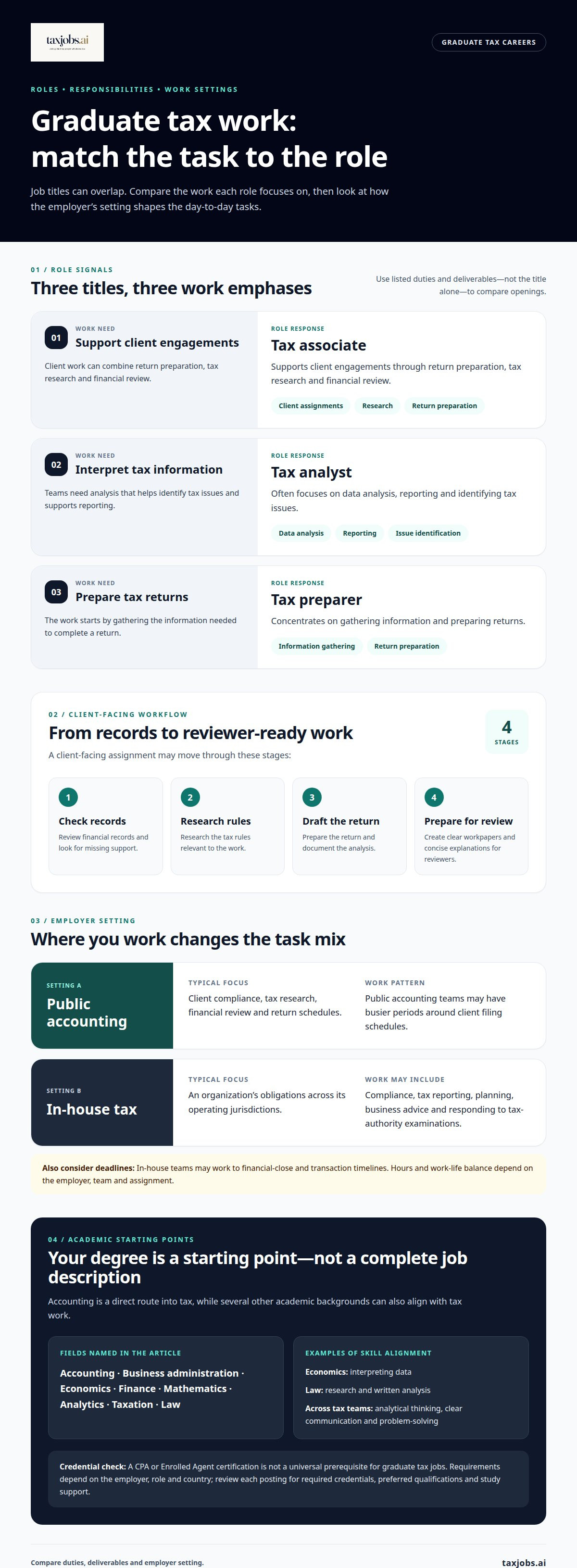
Graduate tax jobs can suit graduates in accounting, business administration, economics, finance, mathematics, analytics, taxation or law. The best fit depends on the role, but analytical thinking, clear communication and problem-solving are useful across tax teams.
Tax work goes beyond preparing returns. Graduates may review financial information, research tax rules, support compliance and tax reporting, contribute to planning, and explain findings to colleagues in finance, legal and business teams. The balance varies by employer and specialty, from corporate and indirect tax to international tax, transfer pricing and global mobility. Your degree can be a starting point, not a complete job description. This article outlines how academic backgrounds can align with tax roles, what graduate tax professionals typically do, and how duties differ across employer settings. Use it to identify role types that match your training and interests as you plan your first steps.
Key Takeaways
- Use your degree as a starting point, then match your skills and interests to the tax specialty and employer setting.
- Compare day-to-day responsibilities across public accounting, corporate tax and specialist teams before choosing a role type.
- Assess starting salary in context: role scope, employer and location shape compensation, so compare like-for-like positions.
- Use taxjobs.ai’s specialty directory and hand-picked roles to narrow your search to opportunities aligned with your career focus.
Academic backgrounds for tax roles
Accounting is a direct route into tax, but it is not the only one. Business administration, economics, finance, mathematics, analytics, taxation and law can also align with tax work. An economics graduate, for example, may bring experience interpreting data; a law graduate may be well suited to research and written analysis. Compare your coursework with the duties listed in each role.
For government tax examiner, collector and revenue agent roles in the United States, a bachelor’s degree in accounting or a related field is needed for most positions, according to the U.S. Bureau of Labor Statistics. Government tax roles and degree requirements differ internationally. Private-sector employers may set different degree criteria. PwC also identifies curiosity, collaboration and problem-solving as useful across tax teams, regardless of major.
A CPA or Enrolled Agent certification is not a universal prerequisite for graduate tax jobs. Requirements depend on the employer, role and country, so read each posting for required credentials, preferred qualifications and any study support.
Graduates can find tax roles at Big Four firms, law firms, government agencies and in-house corporate departments. Graduate opportunities at EY illustrate firm-based entry routes, while Goldman Sachs is an example of an in-house tax team. Employers and available roles vary by country, shaping the work and training environment.
Entry-level prospects vary by specialty, employer and location. One US job-listing snapshot contained 91 tax graduate-scheme roles. That figure signals openings in the snapshot, not a forecast; demand and available roles change with hiring needs across markets.
Career progression can lead from graduate or associate work to specialist and senior responsibilities. Tax accounting, compliance, transfer pricing and international tax offer different paths across countries. Salary growth depends on experience, specialization, qualifications and responsibility, rather than following one standard timetable.
Graduate roles may be tied to a specific office, while some postings describe hybrid arrangements. As location and work models vary by employer and position, review the listing details when comparing opportunities in the United States and other countries.
Typical tax job responsibilities
Tax work combines return preparation, financial analysis, legal research and communication. A graduate may organize source documents, compare accounting records with tax data, identify missing support and prepare workpapers for review. In a corporate team, this analysis can inform tax reporting or business planning. The task mix depends on whether the employer serves clients or manages its own tax obligations.
A tax associate commonly supports client engagements through return preparation, tax research and financial review. A tax analyst often focuses on data analysis, reporting and identifying tax issues. A tax preparer concentrates on gathering information and preparing returns. Because titles overlap, compare the listed duties and deliverables rather than relying on the title alone.
For client-facing work, the process may move from checking financial records to researching relevant tax rules, drafting a return and preparing it for review. Tax professionals may also develop planning strategies, work with colleagues across disciplines and present recommendations. Clear workpapers and concise explanations help reviewers and business teams follow the analysis behind a conclusion.
In-house tax teams manage an organization’s obligations across its operating jurisdictions. Their work can include compliance, tax reporting, planning, business advice and responding to tax-authority examinations. A transaction, for example, may require tax analysis alongside input from accounting and legal colleagues. These duties support compliance and help the business identify and manage tax risk.
Workload often follows filing, reporting and transaction deadlines. Public accounting teams may have busier periods around client filing schedules, while in-house teams also work to financial-close and transaction timelines. Hours and work-life balance depend on the employer, team and assignment. Review the posting’s schedule and responsibilities to understand the expected pattern.
What entry-level tax jobs are available for recent graduates internationally?
Graduates in many countries can explore public accounting, corporate tax, government and specialist teams. Common entry titles include tax associate, tax analyst, tax accountant and tax preparer. Each title can involve a different mix of work, so compare the listed duties before deciding which opening fits your training.
Public accounting firms hire graduates into associate roles supporting client compliance and tax research. The work may include organizing financial information, preparing return schedules and documenting findings for senior review. If you are interested in client assignments, check whether a posting covers multiple industries or focuses on a particular tax area.
Corporate tax departments offer in-house routes, including analyst and accountant positions. Tax teams at financial institutions, such as Goldman Sachs’ Tax team, illustrate the range of work: compliance, tax reporting, planning, business advice and tax-authority examinations. Depending on the employer’s structure, entry-level roles may support analysis or reporting within these functions.
Government tax agencies also employ entry-level professionals in examination, collection and revenue roles. In the United States, the U.S. Bureau of Labor Statistics reports that most tax examiners and collectors, and revenue agents, need a bachelor’s degree in accounting or a related field. Check each announcement for its education criteria and core duties, which can vary by country.
Specialist openings can include transfer pricing, global mobility, indirect tax and tax technology. These roles apply tax skills to focused business questions, such as cross-border pricing or tax data systems. Search by title and specialty, then compare the stated coursework, experience and location requirements. An associate role may suit a recent graduate, while an analyst opening may emphasize data and reporting.
Use employer type and day-to-day duties to narrow your search. Client-service roles can offer exposure to multiple engagements, while corporate roles focus on one organization’s tax operations. Graduate tax jobs appear under different titles across countries, so search related terms and assess the responsibilities instead of relying on a single label.
What is the average starting salary for tax graduates internationally?
There is no single starting salary for tax graduates across international markets. A public accounting associate, an in-house tax analyst and a government revenue role have different responsibilities. Compare compensation across openings with similar duties, employer types and locations. A national figure without those distinctions would not show what a particular role pays.
Start with the job title, then read the responsibilities. A tax associate may support client engagements, while a corporate analyst may focus on reporting and data. A government position may involve examination or collection work. These differences affect the role’s level and compensation structure. Employer, location and work arrangement also matter when assessing an offer.
Use a consistent comparison method. First, group postings by title and employer type. Then compare roles in the same city or labor market, and note whether compensation is stated as annual pay, hourly pay or another basis. Across countries, consider local currencies and pay conventions. An annual salary and an hourly rate cannot be compared directly without considering scheduled hours and employment terms.
Check what the stated compensation includes. A posting may list base pay separately from other compensation components, so read the full terms rather than comparing headline figures alone. Also compare required experience, duties and progression paths. A role focused on return preparation differs from one centered on tax research, financial reporting or specialist analysis.
For graduate tax jobs, use current postings from relevant countries to make like-for-like comparisons rather than relying on one blended average. Record each opening’s title, location, employer type, responsibilities and stated pay basis. This gives you a practical view of opportunities relevant to your profile and helps you set salary expectations in context.
A meaningful average depends on the roles, employers and locations included, so one figure cannot represent all tax graduates. Compare similar openings to set a relevant expectation.
Taxjobs.ai
Once you have identified suitable role types and compensation factors, taxjobs.ai gives you a focused place to explore tax vacancies. The job board covers career stages from graduate internships to partner positions and includes employers such as Big Four firms, law firms and corporate tax departments. This range helps you compare entry routes and employer settings within a specialist tax job board.
For an initial search, browse Featured Hand-picked Roles, then explore the Tax Specialty Job Directory for roles grouped by areas such as transfer pricing, VAT/GST, Pillar Two and tax technology. Specialty categories can help narrow your search when a broad title such as tax associate does not make the work clear. Read each posting for responsibilities, location and stated experience requirements.
Standard Job Postings and the Recruiter Dashboard support the platform’s job-board experience. For candidates, the practical benefit is access to tax-specific vacancies rather than a general list of accounting roles. Compare, for example, an associate opening in public practice with an in-house analyst role, then assess which duties suit your degree and preferred work setting.
taxjobs.ai also connects compatible AI clients to live tax jobs and related knowledge through MCP, the Model Context Protocol. This protocol lets compatible AI applications connect with services that provide information. Streamable HTTP is the connection method supported for those clients. Use this route if your AI client supports MCP and you want to access tax job information through it.
Use the platform when you have a target specialty, employer type or entry-level title in mind, or when you want to explore the range of tax roles available. Opportunities are organized for tax professionals at different career stages.
Contact taxjobs.ai if you have a question about the platform.
Frequently Asked Questions
What qualifications and degrees do graduate tax jobs require?
Requirements vary by employer and specialty. Some postings accept related academic disciplines, while others prioritize specific tax coursework or professional credentials. A CPA or Enrolled Agent credential is not universally required for entry-level roles. Read each posting closely: separate mandatory qualifications from preferred ones, then connect your education, projects or relevant experience to the stated criteria.
How can new graduates find and apply for tax jobs?
Tailor each application to the opening. Identify the role’s specialty, employer type and core requirements, then select relevant examples from coursework, internships or part-time work. For example, use a data project to demonstrate analytical skills for a tax analyst role. Keep a record of applications and deadlines to track follow-ups and prepare consistently for interviews.
What does a typical day look like in a graduate tax job?
The day is usually shaped by team priorities and assigned work, rather than a fixed routine. You may start by aligning on deadlines, spend focused time on an assigned question, then coordinate with colleagues who have related information. A brief status update can help a senior team member set next steps. The balance between independent work and collaboration varies by team.
What is the job outlook for entry-level tax professionals?
A US search snapshot listed 91 tax graduate-scheme roles and 235 entry-level tax jobs. These figures show available US openings at that time, not a global forecast; prospects vary by specialty, employer and location, and openings change with hiring needs.