
The best fit among tax jobs by specialty depends less on the job title than on the work you want to own. Preparation focuses on returns and supporting documents; compliance centers on reporting obligations, controls, and deadlines.
Compare specialties by subject and day-to-day duties. Roles in VAT/GST, transfer pricing, Pillar Two, and tax technology can involve different mixes of analysis, documentation, stakeholder collaboration, and systems work.
This guide shows you how to assess tax specialties against your skills and career goals. Compare preparation and compliance work, identify duties across specialist paths, and narrow your options by the tasks you’ll handle regularly and the skills you want to build.
Key Takeaways
- Separate return preparation from compliance work by identifying the recurring deliverables and responsibilities in each role.
- Match credentials and education to the specialty and level of responsibility you’re targeting.
- Compare public accounting, corporate tax, government, and law firm roles by their work environment and typical focus.
- Use the Tax Specialty Job Directory to explore openings by area of tax and find roles aligned with your goals.
Tax preparation and compliance
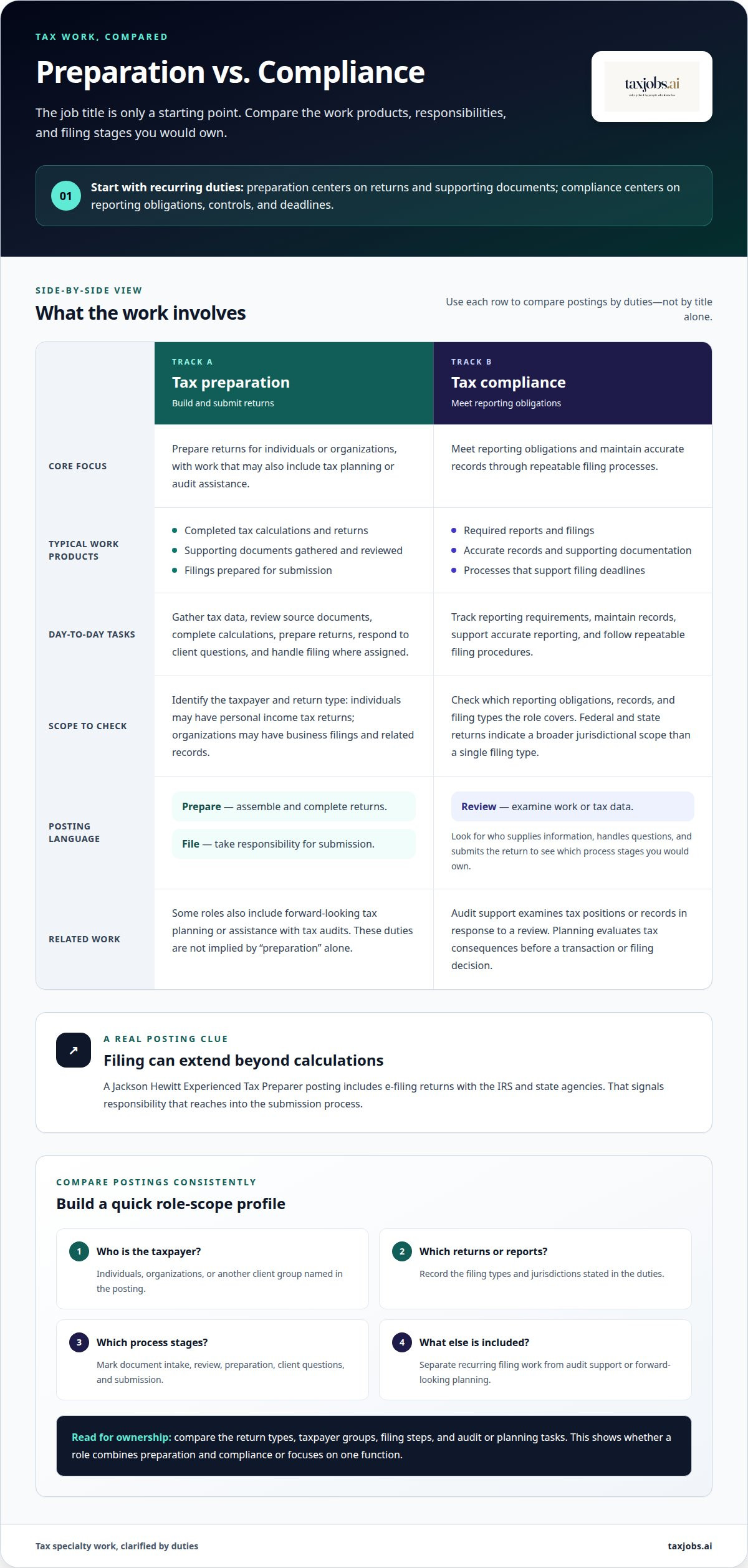
- Separate preparation work from compliance work before comparing job titles. In the United States, tax preparers primarily prepare returns for individuals and organizations. A tax specialist may also prepare federal and state returns, support tax planning, and assist with tax audits. These responsibilities can overlap, but the regular deliverables differ. Return preparation involves gathering tax data, completing calculations, and producing filings. Compliance involves meeting reporting obligations and maintaining accurate records. Read each posting to see which work products you would own.
- Identify the taxpayer and return type named in each job description. A role serving individuals may involve personal income tax returns, while a position serving organizations may cover business filings and related records. The client or entity determines which source documents, transactions, and questions you handle. For example, individual and corporate tax roles may both involve return preparation, but require familiarity with different taxpayer information. Compare the client group and filing scope before treating two “tax preparer” titles as equivalent.
- Map the preparation cycle to the tasks you prefer. Look for references to document intake, data review, return preparation, client questions, and filing. For example, a Jackson Hewitt Experienced Tax Preparer posting includes e-filing returns with the IRS and state agencies. That indicates work beyond calculations, extending into the submission process. If you prefer structured production, prioritize postings focused on preparing and filing returns. If you prefer analyzing issues, look for tax planning or audit support duties.
- Distinguish filing compliance from audit and advisory work. A compliance-focused role may emphasize accurate reporting, supporting documentation, and repeatable filing processes. Audit support involves examining tax positions or records in response to a review. Planning evaluates tax consequences before a transaction or filing decision. A tax specialist may work across these areas, so don’t infer the full scope from “tax” in the title. Use the listed duties to determine whether the position focuses on recurring filings, review, or forward-looking analysis.
- Check how the posting defines responsibility. “Prepare” may mean assembling and completing returns; “review” signals examining work or tax data; “file” identifies responsibility for submission. A posting that specifies federal and state returns describes a broader jurisdictional scope than one focused on a single filing type. Look for who supplies information, handles questions, and submits the return. These details show whether you would own the full process or contribute to one stage.
- Compare the mix of duties in tax preparation and compliance roles side by side. List the return types, taxpayer groups, filing steps, and audit or planning tasks named in each posting. Mark the tasks that match your experience and those that would help you build new skills. This makes tax jobs by specialty easier to assess than titles alone. It also shows whether a position combines preparation and compliance or focuses on one function.
What qualifications and certifications are required for each tax career specialty?
- Match your credentials to the work described, not just the specialty label. Preparation, compliance, audit, and advisory roles can have different requirements. A bachelor's degree in accounting, finance, or business administration can provide a foundation for tax work. Compare your background with the posting’s duties, such as return preparation, tax analysis, or audit support. Distinguish required qualifications from preferred ones when assessing your fit.
- For U.S. roles involving client representation before the IRS, focus on the credential requirement. For roles involving IRS representation, check the posting for the credentials it requires. Candidates seeking enrolled agent status must pass a three-part exam. This credential is relevant when a role includes taxpayer representation, not simply return preparation. Look for explicit representation duties before assuming every preparation role requires an enrolled agent credential.
- Assess the CPA path in relation to your target role and state. The American Institute of Certified Public Accountants offers the CPA exam, while candidates must meet their state’s licensing requirements. Those requirements determine eligibility to practice as a CPA. A role combining tax with broader accounting work may make the CPA path relevant. For a position focused on a narrower tax function, compare its duties and credential criteria before assuming CPA licensure is required.
- Use government postings to identify precise education criteria. New York State Auditor Trainee 1 (TAX) candidates can qualify with a bachelor’s degree that includes 24 credits in accounting, auditing, or taxation. This example shows why degree title alone may not establish eligibility. A transcript’s course content can matter. For other government tax positions, assess the qualifications stated in that specific posting rather than carrying New York’s criteria into another jurisdiction.
- Separate educational foundations from role-specific credentials. Accounting, finance, or business administration can support entry into tax work, while IRS representation roles have the CPA or enrolled agent requirement described above. Transfer pricing, VAT/GST, and tax technology positions may emphasize different technical duties. Identify the specialty’s core work, then compare its stated education, licensing, and examination criteria with your experience.
- Turn qualification gaps into a focused search filter. If you meet the stated education criteria but lack a credential, prioritize postings that list it as preferred rather than required. If you hold a CPA or enrolled agent credential, examine whether the role actually uses it through representation, review, or other listed duties. Browse roles by tax specialty to compare openings against your qualifications and target work.
How do tax jobs differ between public accounting, corporate tax departments, government, and law firms?
- Compare public accounting roles by their client-facing structure. Firms such as the Big 4 serve multiple organizations, so tax professionals may work across different client matters and tax specialties. A posting might emphasize a particular area, such as transfer pricing or VAT/GST, within a broader practice. Look for the named client group, specialty, and level of responsibility. A graduate role and a partner role can sit within the same firm but involve different scopes of work.
- Assess corporate tax roles in the context of their in-house setting. The tax team supports its employer’s tax function rather than a portfolio of external clients. That changes how compliance, planning, and coordination with other departments fit into the role. Review the posting for its specialty, such as tax technology or Pillar Two, and note which business activities it supports. An in-house transfer pricing role, for example, operates within one company’s structure.
- Read government postings for the agency mandate and role classification. A Revenue Tax Auditor position in Pennsylvania differs from an in-house corporate role through its public-sector setting and audit focus. New York State also advertises Auditor Trainee 1 (TAX) positions. Compare the job title, agency, and described duties to determine whether the role centers on tax auditing, information support, or another function. Government roles may also specify education criteria directly in the posting.
- Evaluate law firm roles by their legal setting and title. Tax attorney openings, including New York State tax enforcement positions, point to work connected to legal practice or public enforcement. Compare the required legal qualification with the matters named in the description. A law firm tax role and a government attorney role may both involve tax law, but their employers have different mandates. Use the stated clients, agency, and subject matter to identify the work environment.
- Build a four-column comparison before applying: employer type, specialty, stated duties, and qualification requirements. Place a Big 4 transfer pricing opening beside an in-house transfer pricing role. Then compare each with a government auditor or tax attorney posting. The specialty name alone won’t show differences in employer context or scope. Use the Tax Specialty Job Directory to find openings across employer types and compare roles against your preferred setting.
Taxjobs.ai: Tax Specialty Job Directory
Once you’ve identified a specialty, use taxjobs.ai to compare relevant openings. Its Tax Specialty Job Directory organizes roles by area, including transfer pricing, VAT/GST, Pillar Two, and tax technology. Narrow your search by the work you want to do, then compare each posting’s duties, employer type, and seniority level.
The directory covers opportunities across employers such as Big 4 firms, law firms, and in-house corporate departments, with roles ranging from graduate internships to partner positions. That range helps you assess how a specialty appears at different career stages. For recruiters, Standard Job Postings, a Recruiter Dashboard, and Featured Hand-picked Roles support job advertising and role discovery.
Explore the Tax Specialty Job Directory and tax recruitment options on taxjobs.ai to find a focused way to reach tax professionals.
Set Your Next Career Filter
Choose a specialty based on the work you want to deepen, then use it to guide your next move. A useful filter is more than a tax topic: it also reflects the level of analysis, ownership, and collaboration you want in your day-to-day role. Keep that filter specific as you compare openings, and adjust it when a role offers a chance to develop a skill you value.
Your approach to tax jobs by specialty can evolve. An early move might build technical depth; a later one could change your employer setting or broaden your responsibilities. taxjobs.ai organizes opportunities around tax-specific roles, giving you a focused place to continue your search.
Explore tax roles at taxjobs.ai and find openings that align with the direction you want to take. A clear filter can make the next step more deliberate.
Frequently Asked Questions
What are the main tax job specialties in the United States?
U.S. tax roles also include payroll, property, estate and trust, and excise tax specialties. Their focus varies by tax base: employment, assets, fiduciary entities, or specific goods and activities. For example, an estate and trust role centers on fiduciary tax matters, while a property tax role focuses on property-related assessments and records. These distinctions can help you find niche openings beyond broad tax titles.
What are the most in-demand tax specialties, such as corporate, international, or state and local tax?
No single specialty leads demand across every employer and location. Corporate, international, and state and local tax openings vary with an organization’s operations, reporting footprint, and hiring needs. Compare current postings for your target location and career level. Note how often each specialty appears, which technical skills employers request, and whether the duties align with the work you want to pursue.
What is the average salary for tax jobs by specialty in the United States?
Reported median total pay is $74,000 for tax specialists, $96,000 per year for tax accountants, $116,000 per year for tax consultants, and $164,000 per year for tax managers.
Which tax specialties have the highest earning potential?
Tax managers have the highest reported median total pay at $164,000 per year, followed by tax consultants at $116,000 per year.
What is the job outlook for tax professionals by specialty in the United States?
The U.S. Bureau of Labor Statistics projects accounting jobs to grow by roughly 5 percent from 2025 to 2035. This projection is for accounting jobs overall, not broken down by tax specialty.