
In-house tax jobs place tax professionals inside a company, where they support compliance, financial reporting, planning, and business decisions. Responsibilities vary by role and employer, from preparing returns and managing indirect tax to advising on transactions, tax risk, and cross-border activity. This guide outlines common roles, their responsibilities, and how tax teams contribute across a business, helping you assess which career path fits your experience and specialty.
Key Takeaways
- Distinguish company-based tax work from client-service roles by looking at who the team supports and how it works with business units.
- Map entry-level, specialist, and leadership titles to the responsibilities and experience each role requires.
- Assess how compliance, reporting, planning, and cross-functional coordination shape a tax team’s day-to-day work.
- Use your technical strengths and career goals to identify a path toward deeper specialization or tax leadership.
What are in-house tax jobs?
In-house tax jobs place tax professionals within a company. The team supports the employer’s operations, entities, transactions, and reporting rather than serving external clients. At Goldman Sachs, Tax manages the firm’s worldwide taxes and advises on tax implications related to its businesses and transactions, including investment funds managed by the firm. This example illustrates the internal remit: tax analysis is closely connected to the company’s activities.
Public accounting and external advisory roles usually serve multiple clients, with assignments shaped by each engagement. In-house professionals focus on one employer’s entities and decisions. A team might review a planned acquisition, coordinate tax-return data, or explain a tax provision to finance colleagues. The work links technical analysis to internal deadlines and business processes. External advisers can provide specialist analysis; the company’s tax team applies relevant conclusions across its operations and coordinates with finance, legal, and business teams.
An employer-side role can involve identifying which entity has a tax obligation and understanding how that obligation relates to the company’s work. The Legal Information Institute states that the employer is liable for the tax imposed under subsection (a). This illustrates why a company’s tax function connects legal responsibility with internal analysis and reporting. The work goes beyond interpreting a rule in isolation: it helps the employer consider tax matters in the context of its operations. That can mean clarifying information for colleagues, coordinating records, and explaining tax implications to people involved in company decisions. The balance of responsibilities depends on the position, so a title alone does not tell you everything. Counsel, manager, and other in-house titles can describe different roles; check the listing to understand what that employer expects. The central distinction for job seekers is who the tax professional supports: an internal team serves the employer, while an external adviser serves clients through engagements.
An in-house tax position does not necessarily require daily office attendance. Read the location and work arrangement together rather than assuming that a city in the listing means the role is office-based. Expectations differ between openings. For example, a New York Tax Manager listing describes a hybrid schedule with three days in the office. Tax counsel roles may be hybrid or fully remote, so check each listing for its location and pay. These details help you assess the practical conditions alongside the job’s internal tax remit, rather than treating all in-house openings as alike. The examples do not set a standard schedule or pay level for the field; they show why the terms of each opening matter.
Compensation also needs careful interpretation when comparing in-house roles. Tax counsel salaries shown in job listings may be base salary only, and in-house compensation may also include bonuses, equity, and long-term incentives. A posted range should therefore be read as information about the listing, not automatically as a complete account of total compensation. Job seekers can check whether a listing explains what the stated salary covers and whether it describes additional components. The search returned 1,030 tax counsel job results, but the result count alone does not explain the duties, work arrangement, or compensation for any particular position. Each opening should be considered on its own terms: its responsibilities indicate how the role contributes to the employer’s tax work, while its location and pay details describe important conditions of the opportunity. Taken together, these distinctions make the in-house category broad without making it vague. It identifies the internal relationship of the work, while the individual listing supplies the particulars needed to understand the role.
Common in-house tax roles
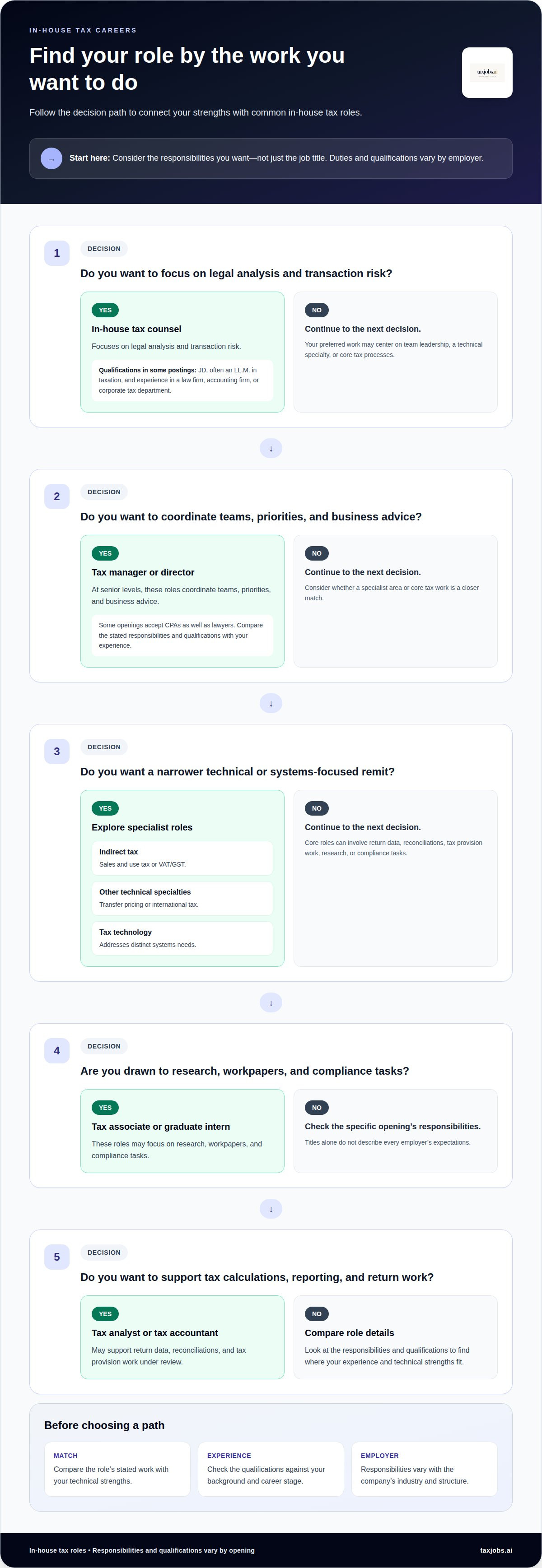
Role titles can indicate scope. A tax analyst or tax accountant may support return data, reconciliations, and tax provision work under review. Tax associates and graduate interns may focus on research, workpapers, and compliance tasks. The employer’s industry and structure also shape responsibilities. A multinational group may need entity-level reporting, while a domestic company may focus on federal tax obligations.
Specialist positions have a narrower remit. Indirect tax professionals work in areas such as sales and use tax or VAT/GST. Transfer pricing, international tax, and tax technology roles address distinct technical or systems needs. In-house tax counsel focuses on legal analysis and transaction risk. These postings may seek a JD, often an LL.M. in taxation, along with experience in a law firm, accounting firm, or corporate tax department.
At senior levels, tax managers and directors coordinate teams, priorities, and business advice. Some openings accept CPAs as well as lawyers. Compare the stated responsibilities and qualifications with your experience to identify suitable roles.
Responsibilities in an in-house tax team
An in-house tax team turns tax obligations into scheduled work across the company. Compliance may include preparing or supervising returns, assembling entity-level data, and coordinating filings across jurisdictions. The team may also review tax calculations and reconcile book-to-tax differences. Goldman Sachs Tax prepares or supervises U.S. federal, state, local, and non-U.S. returns.
Tax reporting connects analysis to financial statements. The team supplies tax information and assesses how transactions affect tax positions. Planning evaluates proposed activity before decisions are finalized, identifying tax consequences and risks. This work involves finance, legal, treasury, and operating teams, which provide records or commercial context.
Tax professionals also coordinate responses to taxing authority examinations, maintain supporting records, and explain tax assumptions internally. Finance may provide transaction data, legal colleagues clarify contractual terms, and tax professionals analyze the implications and communicate the required treatment. Responsibilities vary according to the company’s entities, markets, and internal controls.
Skills and qualifications employers seek
Employers look for technical expertise that matches the company’s tax profile. A role focused on financial reporting may require experience with tax provisions and reconciliations. A specialist opening may prioritize transfer pricing, VAT/GST, or tax technology. Tailor your examples to the posting’s stated responsibilities, systems, and entity structure.
Show applied judgment with specific examples. Describe a return cycle you supported, a tax calculation you reviewed, or a process you improved. Explain your contribution, the records or analysis involved, and how you worked with finance or legal colleagues. Goldman Sachs says tax candidates should be comfortable working with numbers, think analytically, and have strong communication and interpersonal skills.
Credentials depend on the role. Accounting positions may favor an accounting qualification, while legal tax work may require legal education. Employers also assess whether you can explain technical conclusions clearly to non-tax teams. For early-career roles, highlight sound research, accuracy, and disciplined workpaper preparation. For specialist positions, emphasize subject-matter knowledge and experience applying it to business activity.
Career paths in in-house tax
Early-career tax professionals may start as analysts or tax accountants, building experience with workpapers, data validation, and recurring compliance processes. As responsibilities grow, they can take ownership of a filing cycle, review tax calculations, and coordinate information across entities. These assignments develop judgment about how tax affects company decisions.
From there, you can build deeper expertise in indirect tax, transfer pricing, international tax, or tax technology. Specialist roles suit professionals who prefer focused analysis and technical ownership. Moving between specialties can also broaden your understanding of how the company’s tax profile fits together.
Leadership progression often moves from senior or manager roles into tax director positions. The shift brings broader review responsibilities, team coordination, and greater involvement in business planning. Some professionals instead move toward tax counsel or another specialist track. Compare job descriptions for decision authority, technical scope, and stakeholder exposure, rather than relying on the title alone. These criteria help show whether a position builds the experience you want next.
Find In-House Tax Roles with taxjobs.ai
taxjobs.ai offers a Tax Specialty Job Directory for readers exploring in-house tax jobs. When you’re ready to move from learning about these roles to searching for openings, use it to continue your search.
The taxjobs.ai team brings tax recruitment expertise. The site also offers Standard Job Postings, a Recruiter Dashboard, and Featured Hand-picked Roles. Its listings span seniority levels from graduate interns to partners and employer types including the Big 4, law firms, and in-house corporate departments.
Frequently asked questions
Can public accounting experience prepare you for an in-house role?
Yes. In your application, connect client-facing work to the needs of an internal team. Explain how you managed competing deadlines, communicated findings, and adapted technical analysis to different business contexts.
How can you prepare for an in-house tax interview?
Prepare examples that show how you approach unfamiliar issues, organize your work, and explain conclusions clearly. Be ready to describe your individual contribution and how you would apply that approach within one company’s operating environment.