
International tax jobs span in-house tax teams, accounting firms, and law firms, with opportunities from graduate roles to leadership positions. The work can include cross-border transactions, tax provision under ASC 740, GILTI, foreign tax credits, Pillar Two, and country-by-country reporting. This article outlines global career paths, common responsibilities, and the qualifications employers may prefer.
Key Takeaways
- Compare international career paths across in-house teams, accounting firms, and law firms, from early-career roles to leadership.
- Identify how specialties such as transfer pricing, tax provision, and global reporting shape day-to-day responsibilities.
- Assess how relevant experience and preferred credentials, including a CPA or a related master’s degree, may fit your target role.
- Read salary information in context by weighing role level, responsibilities, employer, and location.
Global career opportunities
International tax jobs span multinational companies, accounting firms, and law firms. These employers need tax professionals to manage cross-border transactions and coordinate work across jurisdictions. Career paths range from graduate internships to partner roles. Your options depend on your specialty, experience, and preference for advisory, compliance, or in-house work.
Big Four and other accounting firms, law firms, and corporate tax departments hire for these roles. Corporate employers may build internal teams to support international operations, while professional firms serve clients with varied cross-border needs. In-house roles focus on one organization; professional-firm roles typically involve multiple clients.
Yes. The market includes graduate internships, along with roles for experienced specialists and leaders. Early-career candidates can look for positions supporting tax research, compliance, or reporting. Before applying, compare the responsibilities and experience requirements in each posting with your current level.
Tax service lines offer distinct career paths. Transfer pricing professionals analyze how related entities price transactions. International corporate tax teams address cross-border tax matters and reporting. VAT/GST roles focus on indirect tax across jurisdictions. Pillar Two and country-by-country reporting roles center on multinational tax reporting. Tax technology teams support the systems and processes used in tax work.
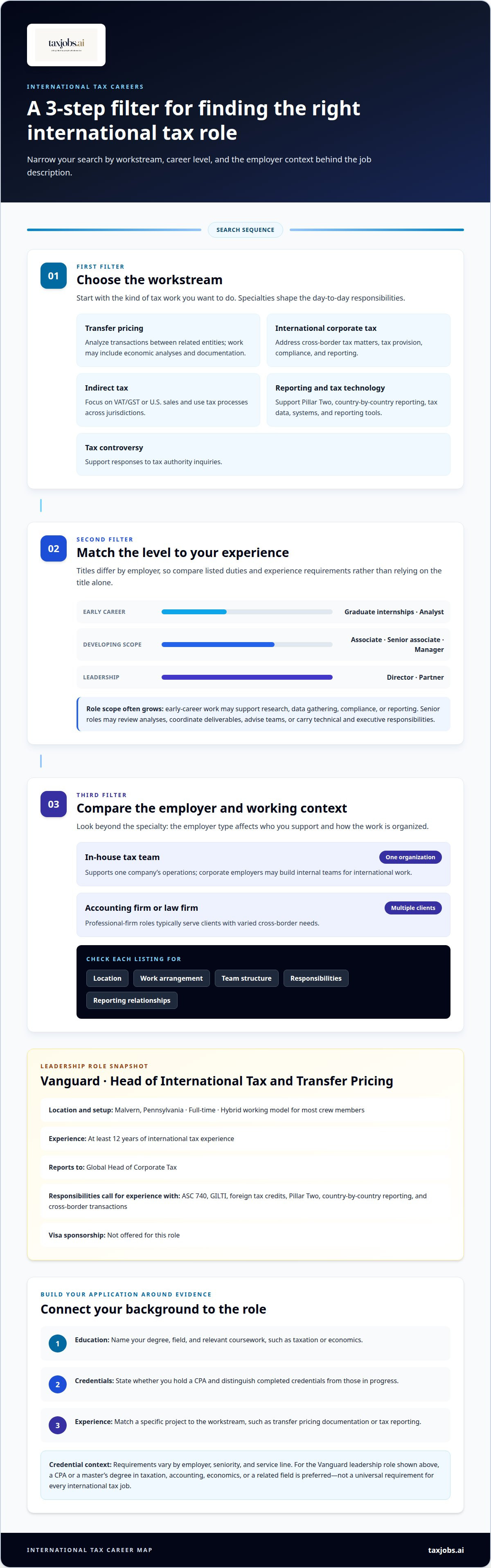
A current leadership example is Vanguard’s full-time Head of International Tax and Transfer Pricing role in Malvern, Pennsylvania. The role reports to the Global Head of Corporate Tax and requires at least 12 years of international tax experience. Its responsibilities call for experience with ASC 740, GILTI, foreign tax credits, Pillar Two, country-by-country reporting, and cross-border transactions. Vanguard uses a hybrid working model for most crew members. The role does not offer visa sponsorship.
To focus your search, choose a service line, such as transfer pricing or tax technology. Then filter opportunities by seniority, employer type, location, and work arrangement. A graduate candidate might target internship postings, while an experienced transfer pricing specialist might prioritize leadership scope and reporting lines.
What types of international tax jobs are available in the United States?
U.S. employers organize tax roles around specific workstreams. An international tax associate may support research, data gathering, and compliance. A senior associate or manager may review analyses, coordinate deliverables, and advise internal teams. Director and partner roles typically combine technical oversight with client or executive responsibilities. Since titles vary by employer, compare the listed duties and reporting relationships.
Transfer pricing roles focus on transactions between related entities. Analysts may prepare economic analyses and documentation; managers may review this work and coordinate with finance or legal teams. Search for titles such as transfer pricing analyst, economist, manager, and director. Scope often depends on whether the employer serves clients or manages one company’s operations.
Corporate tax provision and compliance positions support tax accounting and recurring filings. A tax provision analyst may organize financial data and support reporting calculations. A compliance specialist may coordinate information across business units and jurisdictions. Senior roles often involve reviewing work, resolving process issues, and communicating with accounting leadership. Job descriptions can help distinguish technical analysis from project coordination.
Other openings fall within tax controversy, indirect tax, and tax technology. A controversy specialist supports responses to tax authority inquiries. An indirect tax analyst may work on VAT/GST or U.S. sales and use tax processes. Tax technology roles may map requirements to systems, manage tax data, or support reporting tools. These positions can sit in finance, legal, or dedicated tax teams.
Use a three-step filter to focus your search. First, select a workstream, such as transfer pricing or tax provision. Next, choose a level that matches your experience, from analyst to director. Then compare employer type, team structure, location, and responsibilities. A transfer pricing analyst at an accounting firm may work with several clients, while an in-house analyst focuses on one organization.
Review current tax role listings by specialty and seniority to narrow the field to relevant openings.
What qualifications and certifications are required for international tax jobs?
No single credential applies to every international tax position. Requirements depend on the employer, seniority, and service line. For the advertised Vanguard leadership role, a CPA or a master’s degree in taxation, accounting, economics, or a related field is preferred. “Preferred” indicates an advantage, not a universal requirement for every role.
Use each job description to distinguish required qualifications from preferences. A CPA may support roles involving tax accounting, provision, and compliance. A master’s degree in taxation or accounting can provide relevant academic preparation, while economics may suit positions with analytical or transfer pricing responsibilities. For early-career openings, employers may emphasize education and transferable analytical skills over extensive specialist experience.
Match your technical knowledge to the workstream. A transfer pricing candidate, for example, can highlight experience analyzing related-party transactions, preparing documentation, or supporting economic analyses. A tax technology candidate can describe systems work, tax data management, or reporting process improvements. These examples connect prior experience to the target role without suggesting that one credential alone is sufficient.
Build an application around three evidence points:
- Education: Name the degree, field, and relevant coursework, such as taxation or economics.
- Credentials: State whether you hold a CPA and distinguish completed credentials from those in progress.
- Experience: Match a specific project to the role’s service line, such as transfer pricing documentation or tax reporting.
Compare your experience with the position’s stated level. A graduate applicant can foreground academic preparation and internship work. An experienced candidate can emphasize ownership, review responsibilities, and coordination with finance or legal teams. For a leadership position like Vanguard’s, show how your background aligns with its stated seniority and technical scope. Keep your résumé precise by linking each qualification to a responsibility in the posting.
What is the average salary for international tax professionals in the United States?
One average can obscure major differences between U.S. tax roles. Treat it as a role-level reference, not a national average for international tax professionals. A manager’s specialty, employer, responsibilities, and location all affect compensation.
Compare positions at the same level before interpreting salary data. A transfer pricing manager, for example, may have different responsibilities from an international tax compliance manager. An in-house position may cover one company’s operations, while an accounting firm role may support multiple clients. These differences affect scope, reporting lines, and the experience employers seek.
Use a consistent comparison process when reviewing compensation:
- Match seniority: Compare analyst roles with analyst roles, and director positions with director positions.
- Separate specialties: Review transfer pricing, tax provision, and international compliance roles independently.
- Assess scope: Note whether the posting includes review, team leadership, client responsibilities, or technical ownership.
- Compare location: Keep work location consistent when comparing U.S. opportunities.
Read each posting’s compensation details alongside its stated duties. A range alone does not show whether the role expects ASC 740 knowledge, transfer pricing experience, or oversight of reporting processes. Those requirements can distinguish otherwise similar titles. Also note whether the stated figure is annualized and whether the posting describes base compensation or other components. Avoid treating one employer’s range as representative of every U.S. market or specialty.
Start by identifying your target role level and specialty, then compare postings with similar responsibilities and locations. A director role involving technical review and team oversight, for example, should not be benchmarked against an analyst position. This approach gives you a clearer basis for assessing fit and discussing compensation expectations.
Compare current tax job listings by specialty and seniority to review roles alongside their stated compensation details.
Taxjobs.ai
taxjobs.ai helps you find tax roles by specialty, seniority, and employer type. Its Tax Specialty Job Directory supports focused searches across areas such as transfer pricing, VAT/GST, Pillar Two, and tax technology. Candidates can browse Standard Job Postings and Featured Hand-picked Roles to find openings that match their technical background and career level, from graduate internships to senior positions.
For a transfer pricing search, narrow your focus by role level and responsibilities, then compare openings across accounting firms, law firms, and corporate tax teams. Recruiters can manage job postings through the Recruiter Dashboard. Explore opportunities or discuss recruiting options with taxjobs.ai.
Set your next career direction
A durable path in international tax jobs starts with a clear view of the work you want to own. Consider whether you want deeper technical specialization, broader responsibility across tax functions, or a move between firm and corporate environments. These priorities can help you decide which opportunities deserve attention and which roles represent a meaningful next step.
Use that direction to assess each opportunity’s scope, team context, and development potential. A title alone rarely shows how a role fits your longer-term goals. taxjobs.ai brings together Standard Job Postings, Featured Hand-picked Roles, and a Tax Specialty Job Directory for candidates. Recruiters can manage postings through the Recruiter Dashboard. The platform focuses on tax roles and career opportunities, supported by a team with tax recruitment expertise.
Explore opportunities at taxjobs.ai and identify a next step that fits your career direction.
Frequently Asked Questions
Where can I find current openings for international tax professionals in the United States?
taxjobs.ai displays 20,740 live tax jobs, including U.S. opportunities. Use the listing details to identify the employer, role scope, and application process. Treat the displayed total as a snapshot rather than a measure of openings in one specialty or location. For a focused review, record relevant posting titles and compare their stated responsibilities before applying.
What are the differences between international tax, transfer pricing, and global mobility tax jobs?
These specialties differ in their stakeholders and work products. International tax roles often involve coordination with corporate finance and legal teams. Transfer pricing work commonly involves economic analysis and documentation. Global mobility tax roles coordinate with human resources and payroll around employee assignments. When a posting combines these areas, look for the primary team, expected deliverables, and internal partners to understand the day-to-day focus.
What career paths and advancement opportunities are available in international tax?
Advancement can come through deeper technical ownership or broader responsibility for reviewing work and coordinating projects. To assess a role’s development potential, look for explicit references to review duties, project leadership, or cross-functional collaboration. Moving from preparing analyses to reviewing a team’s deliverables, for example, expands the role’s scope even when the specialty stays the same.
Can international tax professionals work remotely or abroad?
Some roles permit remote work, but remote arrangements do not automatically allow work from another country. Transfer pricing listings indicate that 3% offer remote work. Read the posting’s stated work location and arrangement carefully. For an overseas move, the employer’s location terms determine whether the position supports working abroad; a remote label alone does not settle that question.