
A seasonal tax job posting works best when it defines the work, required experience, and conduct expectations before applications arrive. To post a tax job online, specify the tax scope, seasonal workload, location or remote arrangement, and standards for handling client information and deadlines. Clear criteria help qualified candidates assess fit. This guide explains how to reach seasonal tax professionals in the United States and Canada, set relevant experience and conduct requirements, and choose a posting approach for roles in tax preparation, compliance, indirect tax, and corporate tax.
Key Takeaways
- Define the tax work, required experience, seasonal schedule, and conduct expectations so candidates can assess the role clearly.
- Target seasonal preparers by specifying the tax specialty, workload, work arrangement, and employer needs in the listing.
- Assess free and paid posting options by weighing audience fit, visibility, and the effort required to screen responses.
- Use consistent screening criteria to assess tax experience, credentials relevant to the role, and professional handling of sensitive information.
How do I write an effective tax job posting?
Start with a precise title, such as “Seasonal Tax Associate” or “Canadian Indirect Tax Preparer.” Identify the country, tax specialty, work arrangement, and seasonal start and end dates. State whether the role covers individual returns, corporate compliance, sales and use tax, or another defined area. Candidates can then distinguish the position from year-round accounting work or unrelated tax specialties.
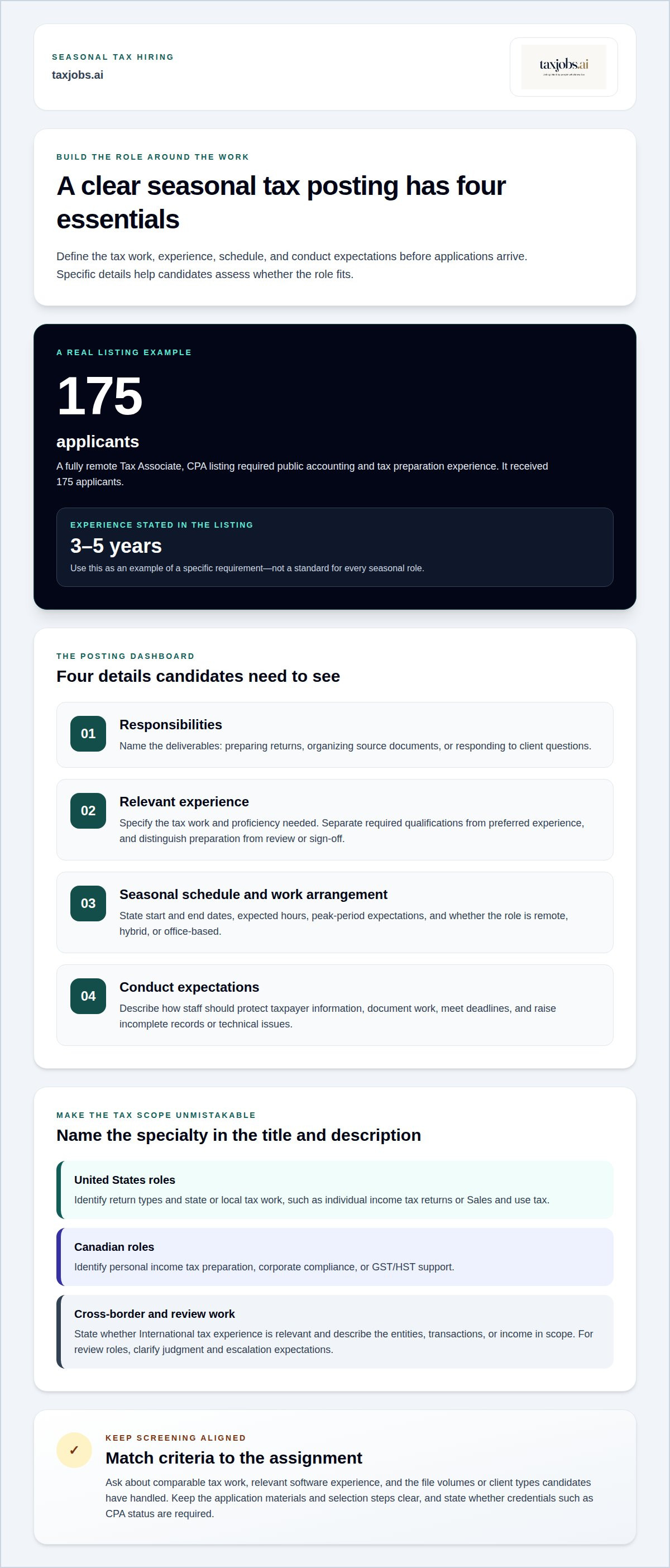
Set experience requirements against the actual work, not an idealized candidate profile. A fully remote Tax Associate, CPA listing requiring 3-5 years of public accounting and tax preparation experience received 175 applicants. Use that example to make each requirement explicit: tax preparation background, relevant client or entity types, and the level of independent review expected. Separate required qualifications from preferred experience.
- Responsibilities: Name the deliverables, such as preparing returns, organizing source documents, or responding to client questions.
- Experience: Specify the relevant tax work and proficiency level. For example, distinguish return preparation from review or sign-off responsibilities.
- Schedule: Describe expected seasonal hours, workload patterns, and any in-office or remote requirements.
- Conduct: State expectations for confidentiality, accurate records, timely escalation, and professional client communication.
Make conduct expectations observable. “Professional” is too broad on its own. Explain that staff must protect taxpayer information, document work clearly, meet assigned deadlines, and raise incomplete records or technical issues through the stated review process. These details help candidates understand how the team handles sensitive files and quality control.
Close with the application steps and required materials. Name the hiring contact or submission channel, list any requested credentials, and explain whether candidates should include examples of relevant tax work. Keep screening criteria aligned with the posting. If the role requires CPA status, say so directly; if it does not, avoid implying that the credential is mandatory.
How can I target seasonal tax preparers when posting a job online?
Reach seasonal candidates through the work they want to do, not a generic “tax professional” label. Distinguish individual return preparation from corporate tax compliance, indirect tax, and review work. A preparer experienced with personal returns may not fit a role focused on business filings. A specific specialty in the title helps candidates spot relevant roles before opening the full description.
Define the seasonal workload in practical terms. State the expected start and end dates, typical weekly schedule, peak-period expectations, and whether the work is remote, hybrid, or office-based. If hours vary with incoming client documents, explain the pattern. Candidates balancing seasonal work with another position need to understand the schedule before applying.
- For US roles: Name the return types and state or local tax work involved, such as individual income tax returns or Sales and use tax.
- For Canadian roles: Identify the relevant work, such as personal income tax preparation, corporate compliance, or GST/HST support.
- For cross-border work: State whether International tax experience is relevant and describe the entities, transactions, or income in scope.
- For review roles: Distinguish preparation from review, including the expected level of judgment and escalation.
Use screening criteria that match the seasonal assignment. Ask candidates to describe comparable tax work, relevant software experience, and the file volumes or client types they have handled. If the position supports individual returns, prioritize evidence of that work. For a GST/HST or sales and use tax assignment, assess experience with the corresponding indirect tax tasks.
Make the application route concise. List the required documents, credential expectations, and selection steps in the posting. A clear process helps seasonal candidates decide whether the role fits their availability and expertise. To reach tax-focused candidates, place the role among seasonal tax job listings rather than relying on a broad accounting label alone.
What are the pros and cons of free versus paid tax job postings?
Free postings can help you test a role description without committing promotion resources. They may suit general seasonal openings, such as an entry-level tax preparation role with a broad candidate profile. Their limitation is visibility: applicants need to find the listing through the platform’s standard search and distribution. A highly specialized role may reach fewer relevant candidates if it competes with general accounting vacancies.
Paid postings can increase a listing’s visibility or placement on a job platform. That may help when you need to reach candidates in a specific area, such as transfer pricing, VAT/GST, or tax technology. Greater exposure does not replace precise screening, though. A promoted listing with vague requirements can attract more unsuitable applications and increase review time without improving candidate fit.
- Free option: Use it to test a clearly scoped role when timing allows and the candidate pool is broad.
- Paid option: Consider added visibility when the position requires a narrow specialty, seniority level, or location.
- Either option: Match the title, duties, and required experience so applicants can self-select accurately.
Compare results using hiring measures, not application volume alone. Track qualified applications, time to the first suitable candidate, and screening effort. For example, a listing that attracts fewer applicants but yields candidates with relevant corporate tax experience may outperform a high-volume posting with mostly unrelated profiles. Use the same criteria across channels to make comparisons meaningful.
Review the posting before changing its distribution. If applicants misunderstand the role, clarify the title, tax work, schedule, or required credentials first. If the listing is accurate but relevant candidates are not seeing it, added placement may address the visibility gap. Keep the application route consistent so differences in results reflect the posting channel, not a changed process.
For a seasonal individual-return role, a free listing may be a reasonable initial test when candidate requirements are broad. For a specialist role involving GST/HST compliance or transfer pricing, targeted visibility may better match exposure to the expertise you need. Choose based on the role’s scope, hiring timeline, and the quality of applicants your current channel produces.
How can employers avoid scams and unqualified applicants when hiring tax professionals
Use a consistent screening process for every seasonal tax application. Match each candidate’s stated experience against the posting’s actual duties. For an individual-return role, ask about preparation work, client communication, and review procedures. For a Canadian GST/HST position, assess relevant indirect tax experience rather than relying on a general accounting title.
Confirm identity and credentials using appropriate records and direct discussion. Ask candidates to explain their role in a specific tax assignment, including the work they completed and how they handled review comments. A qualified preparer should describe their responsibilities clearly. Vague claims such as “handled all tax matters” provide little evidence of relevant experience.
- Check consistency: Compare the application, interview answers, and work history for conflicting dates, responsibilities, or qualifications.
- Use role-specific questions: Ask a US applicant about the return types required, or a Canadian applicant about the GST/HST work involved.
- Set a controlled exercise: Use a fictional scenario to assess organization, judgment, and written explanation without sharing taxpayer records.
- Protect sensitive data: Keep real client information out of recruiting exercises, email attachments, and informal messaging.
Watch for suspicious application behavior, including requests for payment to secure a role, pressure to move conversations to unrelated channels, or inconsistent identity details. Keep communication within the hiring process and document material decisions. For a remote candidate, use a live interview to discuss a specific work example and check that their answers align with their application.
Separate minimum qualifications from preferred experience before screening begins. If CPA status is required, apply that criterion consistently. If the position accepts equivalent tax preparation experience, assess candidates against that stated standard instead. A written scorecard covering technical fit, communication, availability, and handling of confidential information helps interviewers compare applicants using the same criteria.
Keep recruitment focused on verified tax experience and safe handling of candidate information. Post a tax role for qualified applicants with clear screening criteria and role-specific expectations.
Jackson Hewitt franchisees are independent employers and are solely responsible for employment policies and decisions at their locations. Applicants should confirm role requirements and hiring procedures with the specific franchise location, while employers should apply their documented screening criteria consistently.
Taxjobs.ai: Standard Job Postings
taxjobs.ai gives employers a tax-focused way to publish openings through Standard Job Postings. Use this option to reach candidates for seasonal preparation, compliance, or specialist tax roles. A clear title and defined requirements help candidates assess whether their experience matches the work.
For recruiting workflows, the Recruiter Dashboard supports job-posting management. Featured Hand-picked Roles and the Tax Specialty Job Directory offer additional ways to present tax opportunities to relevant audiences. Choose the posting approach that fits the role’s specialty and the visibility you need.
Ready to publish a tax vacancy? Post it on taxjobs.ai using the option that fits your hiring needs.
Set the next hiring step
Before you post a tax job online, align the hiring team on what success looks like after onboarding. Identify who will review completed work, how questions should be escalated, and which assignments require independent judgment. These decisions shape the role and give interviewers a shared basis for evaluating candidates.
For seasonal hiring, connect the process to the work calendar. Decide when applications will be reviewed, who will conduct interviews, and how candidates will receive updates. A defined sequence helps your team handle applicants consistently while keeping recruitment moving alongside tax operations.
The taxjobs.ai team works in a specialist tax hiring context, where preparation, review, and technical tax roles call for distinct candidate profiles. If you’re ready to define the posting and take the next step, contact taxjobs.ai about posting a tax job. A clear hiring brief gives your team a practical starting point.
Frequently Asked Questions
Where can I post a tax job online in the United States?
You can post through taxjobs.ai, a job board for tax-focused roles. Its listings cover specialties such as transfer pricing, tax technology, and VAT/GST, giving employers a tax-specific context for a vacancy. For a US opening, identify the work location or remote arrangement and the tax specialty. This gives candidates useful context to assess whether the role matches their experience.
What qualifications and credentials should a tax preparer job posting require?
Set qualifications according to the work and level of responsibility; a CPA credential is not a universal requirement for every tax preparer role. State whether the position involves preparation, review, or both, then name any credential the role actually requires. Add relevant return types, tax systems, and experience with the client or entity profiles involved. Distinguishing essential criteria from preferences helps avoid screening out suitable applicants unnecessarily.