
SAP tax jobs combine tax operations with enterprise systems. You apply tax knowledge to the design, implementation, or ongoing management of tax-related processes in SAP. The work may include translating tax requirements into system workflows, supporting tax solutions, reviewing process outputs, and coordinating with technology teams. The balance varies by role: some positions focus on compliance and tax operations, while others emphasize implementation or systems analysis.
This guide explains what SAP tax jobs involve, how tax and technology responsibilities combine, and which skills may matter across different roles. It also covers how duties vary by position, what to look for in job descriptions, and how to assess whether an opportunity fits your experience, from early-career work to specialist or senior roles.
Key Takeaways
- Compare role descriptions to see whether each position centers on tax operations, SAP implementation, or systems analysis.
- Assess how your tax experience, SAP knowledge, and project background align with the requirements employers describe.
- Build a focused career path by identifying relevant experience and targeting roles that match your current level.
- Use taxjobs.ai’s specialty directory and curated roles to narrow your search for tax technology opportunities.
SAP tax jobs
SAP tax jobs bring together tax knowledge and SAP configuration, implementation, and support. The work translates tax requirements into system rules, data flows, and review steps. For example, a tax analyst might test whether transaction data receives the intended tax treatment.
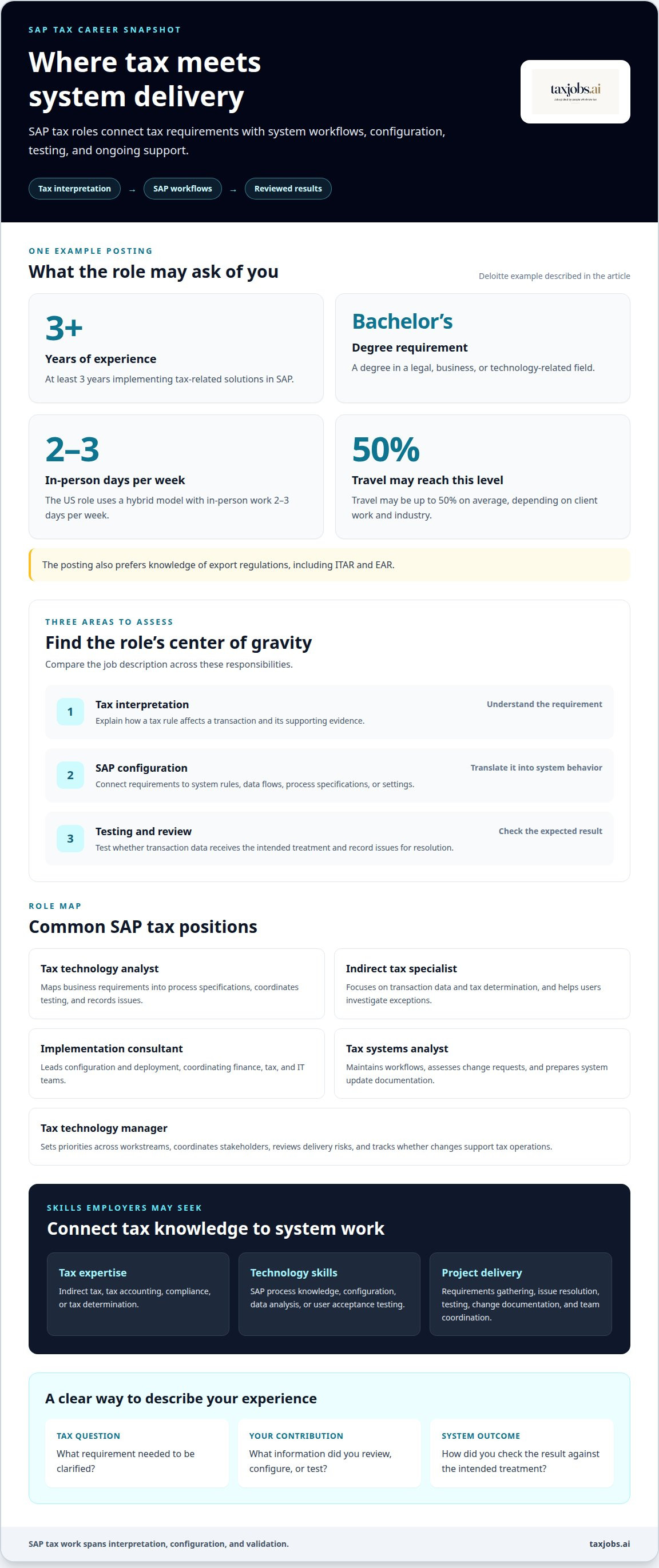
A Deloitte posting illustrates an experienced profile. Applicants need at least 3 years’ experience implementing tax-related solutions in SAP. It requires a bachelor's degree in a legal, business, or technology-related field. Knowledge of export regulations, including ITAR and EAR, is preferred.
Assess each posting across three areas: tax interpretation, SAP configuration, and testing. Then match examples from your work to each area. The US role uses a hybrid model, with in-person work 2-3 days per week. Travel may be up to 50% on average, depending on client work and industry. That mix places the role between tax operations and enterprise technology delivery.
An effective application can show how you move from a tax question to a system outcome. Describe the question in plain language, explain what information you examined, and then connect that reasoning to a configuration decision or a test. Keep the example focused on your contribution: what you needed to clarify, how you checked that the proposed treatment matched the requirement, and what you did when the result did not match. Where possible, distinguish interpreting a rule from translating it into system behavior. That distinction helps an employer understand whether your experience covers only tax analysis, only technical delivery, or the work that connects the two. It also gives you a structure for discussing implementation and support without implying that every project followed the same process. If you have worked with several kinds of transactions or requirements, select examples that show different parts of this chain rather than repeating one task in different words. Be precise about what you personally configured, reviewed, or tested, and avoid claiming responsibility for outcomes that belonged to a wider team.
Tax treatment can depend on the employer, so explain the assumptions behind your work. For the Work Opportunity Tax Credit (WOTC), the U.S. Department of Labor states that taxable employers claim the credit against income taxes, while tax-exempt employers claim it against payroll taxes. If an interview question involves this credit, explain why the employer’s status matters before describing a system treatment. Keep your answer within the requirement: do not assume one configuration applies to every employer or that a system decision replaces tax review. You can describe how you would confirm relevant facts, record your interpretation, and clarify the expected result for reviewers. This shows care with tax-sensitive details while keeping your explanation grounded in the requirement. It also demonstrates how tax interpretation informs system decisions without presenting an example as a universal rule.
In an interview, explain how you would make a requirement reviewable by both tax and technology colleagues. You could describe capturing the business question, identifying the information needed, documenting the intended treatment, and comparing system results with that expectation. Present this as your approach, not as a claim that all employers follow the same steps. When discussing a challenge, explain what was unclear, how you narrowed the issue, and how you communicated the decision or remaining question. A concise example can show judgment as well as technical familiarity: clarify what a test was meant to confirm, not just whether it passed. You can also ask how the role divides interpretation, configuration, and validation, and how those responsibilities are coordinated. This helps you assess the fit and gives the employer a clearer picture of your potential contribution.
Common roles in SAP tax
SAP tax teams often combine tax operations with system delivery. A tax technology analyst maps business requirements into process specifications, coordinates testing, and records issues for resolution. An indirect tax specialist may focus on transaction data and tax determination while helping users investigate exceptions.
An implementation consultant leads configuration and deployment work, translating jurisdictional requirements into system settings and coordinating finance, tax, and IT teams. During a rollout, the consultant may document design decisions, support test scenarios, and manage defects before release. A tax systems analyst may instead maintain existing workflows, assess change requests, and prepare documentation for system updates.
A tax technology manager sets priorities across these workstreams. The role may involve coordinating stakeholders, reviewing delivery risks, and tracking whether system changes support tax operations. Since titles vary by employer, compare the listed duties: configuration, testing, process ownership, and tax interpretation point to different career paths. Target positions that match your experience.
Skills employers seek for SAP tax jobs
Tax expertise helps you assess whether system outputs reflect the intended treatment. Employers may value experience in indirect tax, tax accounting, compliance, or tax determination. Be ready to explain how a tax requirement affects a transaction, its supporting evidence, and the review process. Clear explanations help you translate tax rules into system requirements for technical colleagues.
Technology skills depend on the role. Some positions emphasize SAP process knowledge, configuration, data analysis, or user acceptance testing; others focus on requirements gathering, issue resolution, and change documentation. For example, trace a transaction from source data through tax determination, then explain where an unexpected result needs investigation. This shows how you connect system behavior with tax outcomes.
Project experience matters too. Employers may seek people who can coordinate with finance, IT, and tax teams, manage testing, and communicate implementation impacts. In your application, describe the tax process you supported, your part in the SAP work, and the result. Specific examples distinguish hands-on system experience from general software familiarity.
How to pursue an SAP tax career
Start by choosing your target: tax operations, SAP implementation, systems analysis, or project delivery. Search for the work you want, not just a job title, since employers use different titles for similar responsibilities.
- Search for tax technology, SAP tax, tax systems, and indirect tax roles. Review descriptions for configuration, testing, process ownership, and stakeholder coordination.
- Map each requirement to evidence from your work. For example, connect a compliance task to the system process you supported, the data reviewed, or the testing completed.
- Adapt your résumé for the role. Put relevant tax expertise and SAP project work near the top, then describe your contribution in precise terms.
Prepare interview examples showing how you handled a tax requirement, explained it to technology colleagues, and resolved a process issue. Early-career candidates can use relevant coursework or project experience to demonstrate interest. Experienced professionals can highlight implementation outcomes and cross-functional ownership.
Find SAP tax roles with taxjobs.ai
taxjobs.ai can help you narrow a broad tax job search to systems-focused opportunities. Its live listings span specialties and seniority levels, so you can compare openings by function, employer type, and career stage. For SAP-focused work, look for descriptions that connect tax responsibilities with system delivery, testing, or process ownership.
The Tax Specialty Job Directory organizes opportunities by areas such as tax technology, VAT/GST, transfer pricing, and Pillar Two. Featured Hand-picked Roles offer another way to find selected openings. These options can help you distinguish relevant positions from tax vacancies focused on other work.
Employers can use Standard Job Postings and the Recruiter Dashboard to post vacancies. Candidates can use specialty categories and selected roles to focus their search. Opportunities range from graduate internships to partner roles at Big Four firms, law firms, and in-house employers. The taxjobs.ai team brings expertise in connecting candidates and employers across tax roles.
Contact taxjobs.ai to discuss your job search or recruitment needs.