
Tax compliance jobs span public agencies, accounting firms, law firms, and in-house tax departments, with roles ranging from tax preparation and audit to policy, customer service, and technology. At Virginia Tax, employees work across agency functions and may move between roles based on their skills and interests; specialist positions elsewhere include international tax, indirect tax, and tax technology, while schedules and telework eligibility depend on the employer, position, and work. This guide explains agency roles and specialist fields, how seniority and employer type shape the work, and the schedule options available, giving you a practical framework to identify opportunities that fit your experience and preferences, from early-career positions to senior specialist and leadership roles.
Key Takeaways
- Compare schedule and telework details at the role level; flexibility depends on the position and its work.
- Map agency functions such as audit, tax policy, customer service, and information technology to your interests and transferable skills.
- Assess the technical skills and software requirements in each posting against your experience before narrowing your options.
- Separate recurring compliance and reporting work from tax preparation and advisory responsibilities to target roles that fit your strengths.
Flexible schedules and telework
State and local requirements determine which jurisdictions a tax role covers and what work it involves. Your work location may also affect telework eligibility, depending on the employer’s policy and the position’s duties. Assess these separately: the taxes involved define the role’s compliance scope, while the position and work arrangement determine where you perform the work.
Virginia Tax illustrates how agency policies can connect flexibility to job duties. Telework eligibility depends on an employee’s position and the nature of the work. Tasks requiring in-person coordination may call for a different schedule from work that can be completed remotely. Virginia Tax employees also receive 12 paid state holidays, according to the Virginia Department of Taxation. That benefit is distinct from telework eligibility and should be assessed separately.
Private-sector postings show that “hybrid” can mean different schedules. One Tax Manager role offers three days in the office, while a Senior Tax Associate role requires three days in a New York City office. A senior tax role at a North Shore wealth management firm requires four office days a week. Check the specified office cadence rather than relying on a general remote or hybrid label.
- For agency roles: Compare the position’s duties with its stated telework eligibility. Virginia Tax ties eligibility to both factors.
- For hybrid roles: Record the required office days. The Tax Manager and Senior Tax Associate examples each specify three days.
- For office-heavy roles: Account for the four-day requirement in the North Shore example when assessing commute and work-location fit.
For tax compliance jobs, assess more than the remote-work label. Review the jurisdictions covered, core duties, office schedule, and eligibility terms together. State and local tax work may require coordination specific to particular jurisdictions, while the employer’s telework policy determines where you can perform that work. A clear posting should distinguish tax responsibilities from schedule expectations.
Tax agency roles and fields
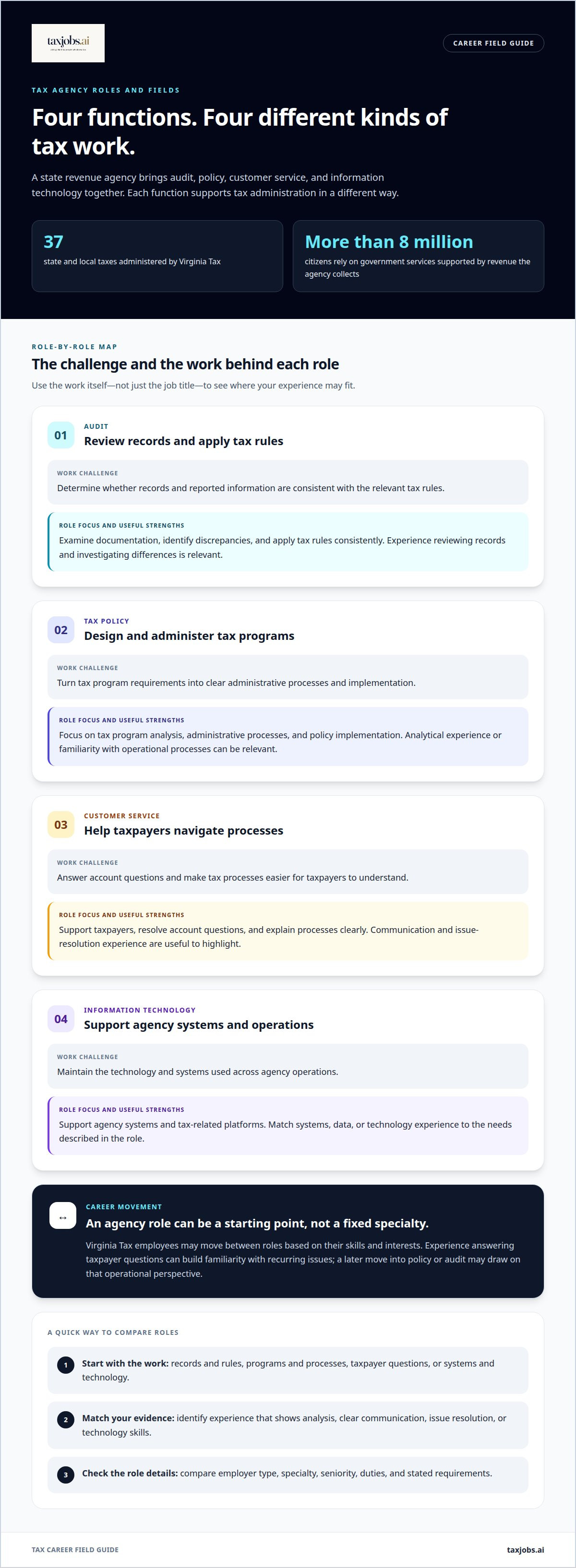
Virginia Tax provides a clear example of the range inside a state revenue agency. Its employees work in audit, tax policy, customer service, and information technology. The agency administers 37 state and local taxes. That scope creates distinct workstreams, from reviewing tax matters to supporting public-facing services and agency systems.
Each field has a distinct focus. Audit roles examine records and apply relevant tax rules. Tax policy roles focus on designing and administering tax programs. Customer service roles help taxpayers understand processes and resolve account questions. Information technology roles support the systems used in agency operations. These are different career paths, even when they contribute to the same revenue function.
Virginia Tax employees may move between agency roles based on their skills and interests. That mobility can make an entry role a starting point rather than a fixed specialty. For example, experience handling taxpayer questions may build familiarity with recurring issues. A later move into policy or audit could draw on that operational perspective. Virginia Tax is headquartered in downtown Richmond, and revenue it collects supports government services relied on by more than 8 million citizens.
- Audit: Look for experience reviewing documentation, identifying discrepancies, and applying tax rules consistently.
- Tax policy: Consider roles that involve analysis of tax programs, administrative processes, or policy implementation.
- Customer service: Highlight clear communication, issue resolution, and the ability to explain tax processes.
- Information technology: Match systems, data, or technology experience to agency operations and tax-related platforms.
Agency experience is only one route into the profession. A public tax manager position in Andover, Massachusetts, prefers a CPA or MST and seeks 5-10 or more years of tax experience. That example represents a different employer type and seniority profile. Compare the work setting, specialty, and stated experience level before deciding which path fits. To scan curated opportunities across employer types, explore Featured Hand-picked Roles alongside agency positions.
What skills and software do employers expect for tax compliance jobs?
Employers assess candidates against a role’s tax scope, reporting duties, and systems. A corporate tax position may involve reconciling provision data with filed returns. An indirect tax role may focus on transaction data and tax coding. Both require accuracy, clear documentation, and the ability to investigate discrepancies. Read the posting for the expected work product, not just the title.
Technical judgment matters as much as execution. You may need to interpret tax rules, identify missing information, and explain exceptions to finance colleagues. If a return differs from the underlying ledger, for example, you need to document the reconciliation. Audit support likewise depends on traceable workpapers and clear links between source records and reported figures.
- Reconciliation: Explain how you traced a return figure to ledger data and resolved a variance.
- Research: Describe how you assessed a tax question and recorded the reasoning behind your conclusion.
- Documentation: Show how you organized workpapers, approvals, and supporting records for review.
- Communication: Give an example of explaining a filing issue to accounting or operations colleagues.
- Systems: Identify the tax, accounting, spreadsheet, or enterprise platforms you have used, when relevant.
Software requirements depend on the employer’s systems and the role’s responsibilities. A posting may name tax compliance software, an ERP platform, spreadsheets, or data tools. Distinguish named systems from broader skills. Spreadsheet proficiency, for example, may involve checking formulas, reconciling datasets, and tracking filing inputs. If the posting names a tax platform, describe the specific work you performed with it.
Tailor your application to the job description by linking each required skill to a task, system, or work product from your experience. Early-career candidates can cite coursework, internships, or supervised return preparation. Experienced professionals can specify entity types, tax areas, review responsibilities, and process improvements. Make software claims precise by connecting your experience to an actual compliance workflow.
How do tax compliance jobs differ from tax preparation and tax advisory roles?
Tax compliance jobs focus on an organization’s tax filing and reporting obligations. The work may include gathering data, preparing calculations, reviewing returns, and keeping supporting records. Deadlines and accuracy shape the workflow, which may also involve coordinating information across finance, payroll, and operations.
Tax preparation focuses on gathering tax information and completing returns. It may be part of a compliance role, but job titles vary by employer. A tax preparer, for example, may collect client documents and prepare individual returns. An in-house compliance analyst may instead reconcile company accounts and coordinate filings across several tax areas.
Tax advisory work analyzes a tax question to inform a decision. An adviser, for example, may assess the tax effects of a proposed transaction. Compliance work generally applies relevant rules to reporting and filing obligations, while preparation focuses on producing returns from available information. Some positions combine these activities, so judge the role by its listed duties rather than its title.
- Compliance: Look for recurring filing, reporting, reconciliation, and documentation responsibilities.
- Preparation: Identify return preparation, client information gathering, and calculation tasks.
- Advisory: Look for analysis, recommendations, and support for tax-related business decisions.
Compare roles by their main responsibility and expected work product. A role responsible for return accuracy and filing processes is compliance-oriented. One centered on preparing taxpayer returns is preparation-oriented. A role focused on evaluating options and recommending a course of action is advisory-oriented. If a posting combines these functions, identify which duties are central and which support the broader tax team.
To compare roles by specialty and responsibility, browse tax job opportunities and assess each posting against the work you want to perform.
Taxjobs.ai
taxjobs.ai connects AI clients to live tax jobs and knowledge over MCP. MCP-compatible clients can connect over Streamable HTTP. Its listings span seniority levels from graduate interns to partners, and employers including Big 4 firms, law firms, and in-house corporate departments. Roles cover specialties such as transfer pricing, VAT/GST, Pillar Two, and tax technology.
Explore the Tax Specialty Job Directory or Featured Hand-picked Roles. Employers can use Standard Job Postings and the Recruiter Dashboard to advertise vacancies.
For questions about tax job opportunities or recruitment listings, contact taxjobs.ai.
Choose your next role with clear criteria
Choose your next move based on the work you want to take on, not just your current title. Define the scope you want next: recurring filing ownership, a narrower specialty, broader review responsibility, or a move into agency work. Then compare roles against that profile to keep your search focused on an environment and career direction that fit your experience.
Tax roles sit within different teams, so compare what success means in each position. One may prioritize reliable reporting cycles; another may emphasize a specialist tax area or coordination across finance. Consider which responsibilities will build the experience you want next. taxjobs.ai curates opportunities across tax specialties and employer types, helping professionals find roles relevant to their experience and interests.
Set your criteria before reviewing your next shortlist. That gives you a practical basis for deciding which openings merit attention and which point toward a different career track. Explore opportunities at taxjobs.ai and apply those criteria to current openings. The taxjobs.ai team’s tax job knowledge supports its opportunity curation. A focused search can help you take a deliberate next step.
Frequently Asked Questions
What does a tax compliance specialist do?
A tax compliance specialist coordinates tax information, filing workflows, and supporting records so an organization can meet its reporting obligations. The work may include maintaining a filing calendar, collecting information from finance teams, tracking approvals, and escalating missing or inconsistent data. For example, a specialist might coordinate a return review by identifying outstanding schedules and recording who approved each submission.
Which industries hire tax compliance professionals?
Tax compliance professionals work across industries with tax obligations, including financial services, real estate and construction, software, logistics and trade, education, transportation, and manufacturing. The subject matter varies: a logistics employer may need customs and trade expertise, while a software company may recruit for corporate or international tax work. Compare each posting’s specialty and business activities with your experience.
Where can I find tax compliance jobs in the United States?
Specialist job boards such as taxjobs.ai display live tax-related positions in the United States. Use the site’s geographic filters, including the United States, California, Texas, New York State, and Florida, to narrow your search. Specialty filters cover indirect tax, corporate tax, international tax, and tax technology. Filter by location and specialty, then review each posting’s duties and work model.
What are common entry-level tax compliance job titles and requirements?
Common entry-level titles include Tax Intern and Tax Preparer. Requirements depend on the employer and role, so read each posting for its education, experience, and technical criteria. For an internship, connect relevant coursework or supervised tax work to the listed tasks. For a preparer position, describe your experience organizing source documents and preparing accurate returns.