
Tax internship jobs offer early-career applicants opportunities in public accounting, government, and in-house teams. Assignments may include tax return preparation, audit work, or accounting support. Since a title alone does not reveal what you will learn, compare the duties, application requirements, schedule, and location.
Opportunities differ by employer and term, and each posting sets its own application window and criteria.
This guide covers how to find and compare early-career tax opportunities, prepare applications and interviews, assess internship assignments, and distinguish tax roles from related accounting placements.
Key Takeaways
- Plan applications around each employer’s term-specific deadlines, and prepare interview examples that connect your coursework to the role.
- Compare internships by their actual assignments, from tax return preparation to audit and accounting support.
- Factor in work location and schedule when assessing whether an opportunity fits your study or commuting arrangements.
- Review each posting’s education requirements separately; accounting coursework and CPA eligibility expectations can vary by practice.
Application and interview process
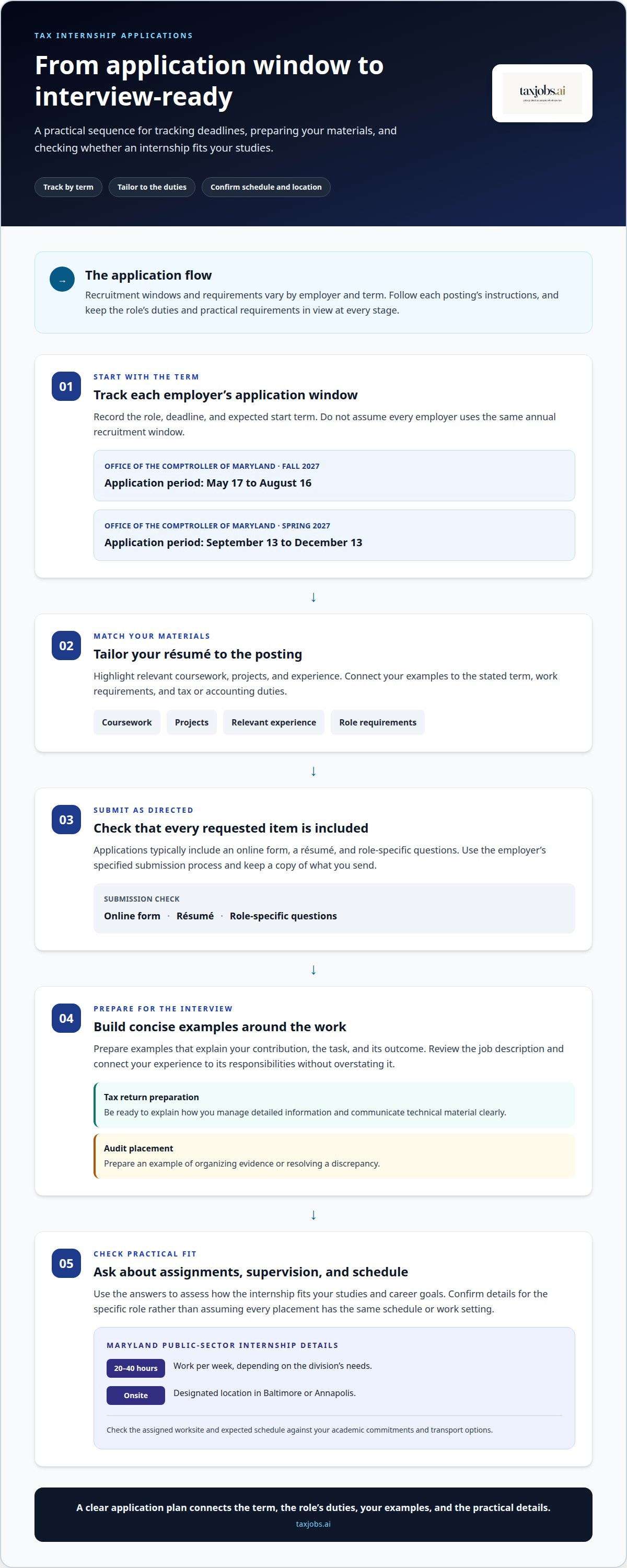
Applications typically include an online form, a résumé, and role-specific questions. For tax internship jobs, tailor each application to the stated term, work requirements, and tax or accounting duties. Keep a copy of what you submit and note the role’s criteria so you can give consistent, specific answers if invited to interview.
Application Steps
Follow the employer’s instructions and submit each requested document through the specified process. Tailor your résumé to the position, highlighting relevant coursework, projects, and experience. Prepare concise examples that describe your contribution, the task, and its outcome. Before an interview, review the job description and connect your experience to its responsibilities. This helps you explain your fit clearly without overstating your experience.
Internship Application Timing
Track recruitment by employer and semester rather than assuming one annual window. The Office of the Comptroller of Maryland’s 2027 fall internship application period runs from May 17 to August 16. Its 2027 spring internship application period runs from September 13 to December 13. These distinct windows make term selection an early application step. Record each deadline alongside the role and expected start term.
Prepare for the work described in the posting. For a tax return preparation role, explain how you manage detailed information and communicate technical material clearly. For an audit placement, prepare an example of organizing evidence or resolving a discrepancy. Ask about assignments, supervision, and the expected schedule. The answers can help you assess how the internship fits your studies and career goals.
Public-sector roles can involve substantial organizations and defined schedules. The Office of the Comptroller of Maryland has more than 1,200 employees, according to the Office of the Comptroller of Maryland. Its internships require 20-40 hours of work per week, depending on the division’s needs. Use these details to frame questions about the division’s responsibilities and weekly commitment. Confirm the specific role’s schedule before accepting an interview.
Early-career opportunities
Early-career tax roles differ by employer, term, and assignment. The Office of the Comptroller of Maryland launched its agency-wide internship program in 2023. It is open to highly motivated college students, graduate students, and recent graduates. That eligibility makes it relevant beyond undergraduates still completing a degree. Applicants should compare the work itself, not rely only on the internship title.
Tax-focused placements may involve preparing individual returns, and some assignments include partnership, estate, or trust returns. This work introduces interns to different records and return types. Audit internships follow a different path: interns may contribute to multiple engagements and gain experience with evidence, documentation, and team review. Accounting internships may focus instead on operational support, reconciliations, or cost accounting. Compare the listed duties to see which skills each placement is likely to develop.
Compare roles by the work interns actually do. A tax return position is a closer fit if you want experience with preparation and supporting documents. An audit placement suits applicants interested in testing records and following review procedures. Accounting support can build familiarity with routine financial processes, although it may involve less tax-specific work. Ask how interns contribute to active assignments and what they produce. These details help distinguish hands-on work from a role focused on observation.
Build a shortlist around practical fit. Match the internship term to your academic calendar, then group openings by assignment, employer type, and location. Note whether each role is explicitly tax-focused or has a broader accounting title. Compare duties such as return preparation, audit participation, and accounting assistance. Tailor your application to the work: a class project involving detailed analysis calls for a different example than experience organizing records or collaborating on a team deliverable.
For international applicants, the employer and jurisdiction influence available role types and application criteria. In the United States, public-sector internships and private-practice placements offer different settings. Compare the work involved, the people or business records you will handle, and the supervision described. This helps you choose an opportunity that builds relevant experience without assuming every internship offers the same tax exposure.
Internship work locations
Location affects whether an internship fits your schedule, transport options, and preferred work setting. The Office of the Comptroller of Maryland structures its internships as onsite roles at a designated location in Baltimore or Annapolis. Treat the city as a practical requirement, not just an employer detail. Before applying, identify the assigned location and consider whether regular onsite attendance fits your academic commitments.
Maryland postings span several cities and employer types. A Spring 2027 Assurance Intern position was listed in Baltimore, while a Winter Audit Intern position was listed in Bethesda. Other examples include a tax and audit internship in Rockville, an accounting internship in Jessup, and an accounting assistant internship in Hanover. These locations show why a state-level search can miss important differences between individual opportunities.
For a location-based shortlist, record each posting’s city, work setting, term, and role title. Group openings by realistic travel area rather than treating every listing in a state as interchangeable. For example, Rockville and Bethesda may involve a different commute from Baltimore or Annapolis. Before prioritizing an application, compare the actual worksite with your transport options and class schedule.
Consider nearby accounting placements when searching for relevant early-career experience. In Phoenix, the Arizona Department of Administration listed a Financial Audit Intern position. Greensboro had a Business Analyst Intern listing, and Fallston had a Cost Accountant Internship. These are not tax internships, but their locations and duties can help you assess the wider early-career market in your preferred area.
Distinguish confirmed work locations from assumptions about flexibility. The Maryland Comptroller internships are onsite at designated locations in Baltimore or Annapolis; other listings name a city but do not describe the work arrangement. Use the posted location to assess geographic fit, then compare the assignment and term. This keeps your shortlist specific and ensures the role’s actual location matters more than a familiar employer name.
Do tax internships require accounting coursework or CPA eligibility?
Requirements vary by employer and practice, so review each posting’s education criteria separately. Ryan requires applicants for its internship to have 6 - 12 accounting hours, depending on the practice. That range makes coursework a specific screening factor for some placements, not a universal threshold for every tax internship. CPA eligibility is a separate criterion; treat it as required only when the individual posting says so.
Coursework requirements can also differ within one employer. A tax credits practice may seek accounting preparation relevant to its assignments, while another practice may emphasize different qualifications. Ryan’s R&E tax credits internship is listed for Summer 2027. Compare the role’s stated course requirements with your transcript, then identify relevant classes in your application. Do not assume that a broad accounting background automatically meets a practice-specific threshold.
Consider academic criteria separately from other application conditions. Ryan’s internship requires a valid driver's license, which is different from accounting coursework or CPA eligibility. A posting may combine education requirements with practical conditions related to the role. Review each requirement individually so you do not overlook a nonacademic condition while focusing only on credits or professional credentials.
For interviews, connect your coursework to the tasks in the posting. A class involving tax returns can demonstrate your familiarity with tax concepts; an accounting course can show how you approach records and detail. If a role requests CPA eligibility, describe your education status accurately. If it does not, focus on the stated qualifications rather than suggesting eligibility is required for all internships.
Use a simple comparison across openings: required accounting hours, preferred coursework, credential language, and any separate conditions. Mark each item as stated, then tailor your résumé and interview examples to the role. This makes differences between tax practices easier to assess without treating one employer’s threshold as an industry-wide rule. Browse tax internship listings to compare openings by specialty and role requirements.
Taxjobs.ai
taxjobs.ai helps you compare early-career openings by role, specialty, and employer type. Listings include opportunities from graduate internships to senior tax positions across public accounting, law firms, and corporate tax teams. Use the range to find roles that align with your coursework, preferred assignments, and location.
Standard Job Postings and Featured Hand-picked Roles highlight openings, while the Tax Specialty Job Directory organizes roles in areas such as transfer pricing, VAT/GST, Pillar Two, and tax technology. These categories help distinguish tax-focused internships from broader accounting placements. Employers can use Recruiter Dashboard to list opportunities.
When you’re ready to move from comparing criteria to reviewing live tax opportunities, explore taxjobs.ai. Contact taxjobs.ai to discuss the platform.
Turn your first placement into a career signal
Choose an internship that gives you work examples to discuss in future interviews. Keep brief notes about the tasks you complete, questions you resolve, and how your work supports the team. These details can make future applications more specific and help you identify which tax work fits your longer-term goals.
As you compare tax internship jobs, focus on the skills and experience each role can add to your career path. Contact taxjobs.ai about tax internship roles to discuss your search. A clear direction can help you take your next career step with confidence.
Frequently Asked Questions
Where can I find tax internship jobs near me?
Browse tax-focused job listings and filter by your preferred region or city. Map view can help you spot openings near campus or within a practical commute. Search related titles such as tax analyst intern or accounting intern, then review the duties to distinguish tax work from general accounting. Compare each role’s stated location and work arrangement.
When do Big Four and other firms recruit tax interns?
Recruitment timing varies by firm, office, and internship term. Big Four firms and other employers may post separate openings for summer, spring, or winter placements. Set job alerts where available and monitor listings throughout the academic year instead of relying on a single recruiting season. Apply according to each posting’s deadline and start term.
How do I apply for a tax internship and what documents are needed?
Apply through the process named in the posting and submit every requested document. Prepare a tailored résumé and application details, including relevant academic information such as completed accounting courses. Employers may request additional materials, so follow each role’s instructions instead of assuming the same application package works everywhere. Keep copies of your submissions to support consistent interview answers.
What interview questions are common for tax internship jobs?
Expect questions about your interest in tax, relevant coursework, and approach to detailed tasks. An interviewer might ask how you would organize unfamiliar records or explain a class project involving financial information. Prepare concise examples that demonstrate your reasoning, accuracy, and communication. You can also ask which assignments interns support and how their work is reviewed.
Can a tax internship lead to a full-time job or CPA career?
An internship can provide relevant experience and help you assess whether tax work fits your goals, but it does not guarantee a permanent role or confer CPA status. A full-time offer depends on the employer’s hiring needs and your performance. CPA eligibility follows separate education and licensing requirements, which vary by jurisdiction. Treat the placement as experience, not a credential.
How much do tax interns earn per hour in the United States?
This is a specific posting, not a national pay range.