
A tax title alone does not show whether a role fits your career direction. Responsibilities, seniority, and workplace matter too. Whether you are entering tax or seeking a specialist move, compare tax job listings with the work you want to do and the experience you bring. Here is how to assess requirements, find relevant opportunities, and choose your next career step.
Key Takeaways
- Assess a role by its specialty, responsibilities, and seniority, not title alone.
- Compare employer type and workplace arrangement with the environment you want next.
- Use role requirements to identify skill gaps and prioritize opportunities that fit your experience.
- Explore taxjobs.ai’s specialty directory and hand-picked roles to narrow your search by area of practice.
Tax job listings
Assess each role by its responsibilities, technical scope, and authority. A title can hide important differences in daily work. A tax analyst may focus on transaction-level compliance, reporting, or systems, while a manager may oversee review processes or coordinate a team. Read the duties first, then compare them with your experience and career direction. This helps distinguish a genuine fit from a familiar-sounding title.
A listing can also place employment information beside tax guidance, so keep the two kinds of content separate when assessing a role. The Internal Revenue Service describes a two percent % of adjusted gross income (AGI) limitation on total miscellaneous deductions and says taxpayers must itemize to claim them. That information concerns deductions, not the duties, authority, or compensation of a job. Treat it as background tax content rather than evidence about what an employee in a listed position would do. For the employment details, identify the position title, location, pay basis, salary range where provided, and application deadline. These details make listings easier to compare without assuming that similar titles have identical responsibilities or that a higher salary alone indicates a better match. If the listing gives an hourly rate, preserve that distinction when comparing it with a listed salary range; the figures describe different pay formats and should not be treated as interchangeable. Likewise, keep location in view, since the opportunities named here are in different New York communities. A careful comparison starts with what each posting actually states and leaves unstated matters open for further review.
That gives candidates a stated hourly figure and a date to check before deciding whether to apply. Because both examples express pay by the hour, their stated rates can be compared directly, while keeping their different titles and locations in mind. The listings do not establish a schedule, duration, or full set of duties unless those details are stated. The trainee and representative wording indicates different role levels, while the salary range offers a starting point for reviewing the specific posting. Confirm which title and pay apply to the opening you are considering rather than assuming every position in a group has the same terms. Compare title, location, pay format, and stated level to decide which listings merit closer review.
These ranges make compensation one visible point of comparison, but the distinct titles and locations matter as well. A candidate should read each posting for its stated responsibilities and authority, then assess whether the work aligns with their background and direction. The titles identify different roles; they do not establish, on their own, the precise scope of daily tasks, supervisory expectations, or qualifications. Do not infer those details from the salary range, and do not assume that the higher listed range automatically reflects a closer fit. A useful review records what is explicitly stated for each opening and identifies any unanswered questions to resolve before applying. Across all the listings, the same approach applies: compare the actual position and its terms, keep compensation formats distinct, and use the title as an invitation to examine the duties rather than as a substitute for them. This keeps a job search grounded in the available details and makes it easier to distinguish a promising opportunity from one that only appears suitable at first glance.
Filter by specialty and function
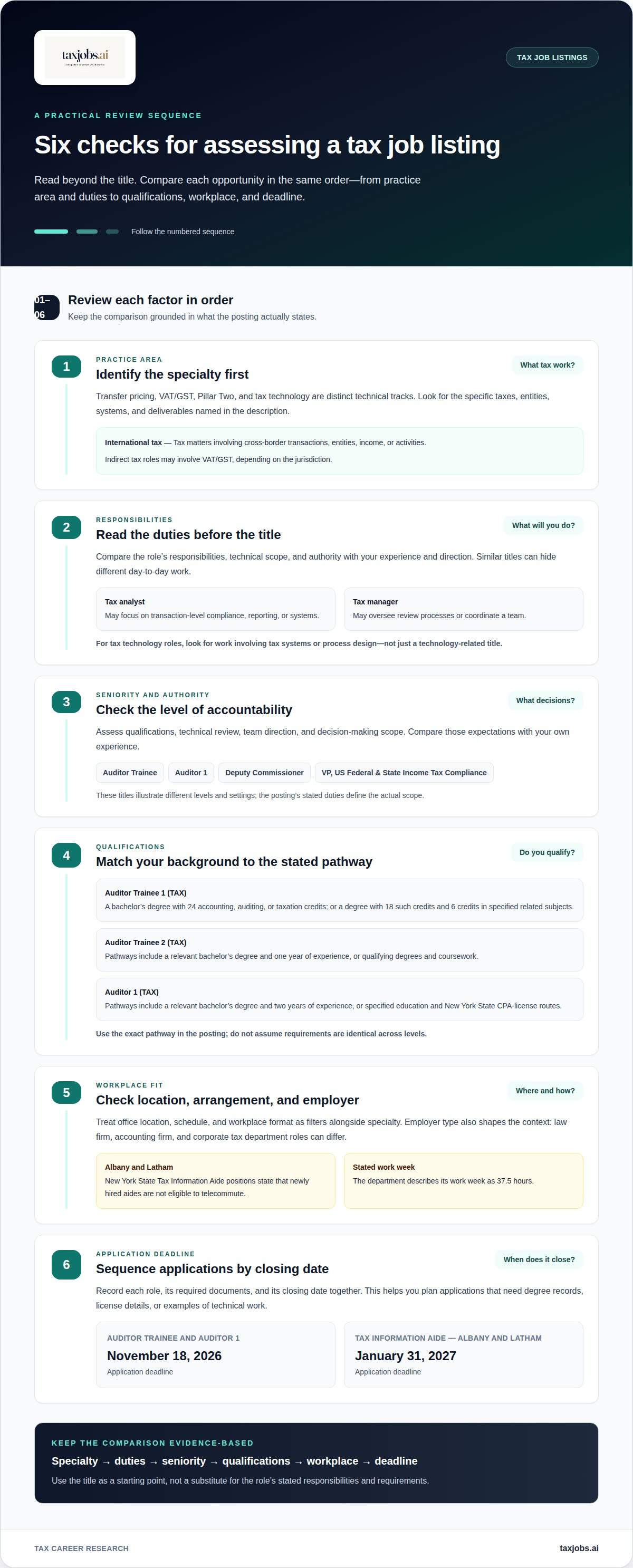
Narrow your options by practice area. Transfer pricing, VAT/GST, Pillar Two, and tax technology are distinct technical tracks. International tax involves cross-border transactions, entities, income, or activities. Indirect tax roles may involve sales and use tax or VAT/GST, depending on the jurisdiction. Look for the specific taxes, entities, systems, and deliverables named in each description. These details show whether a position builds on your expertise or requires a shift in practice.
Role titles can illustrate these differences. Christie’s Indirect Tax Analyst position signals a focus on indirect tax, while Metropolis Technologies’ Senior Director, Indirect Tax role indicates a senior position in the same specialty. Compare their stated duties rather than assuming the roles have the same scope. If you are moving into tax technology, look for responsibilities involving tax systems or process design, not just a technology-related title.
Match seniority to requirements
Evaluate seniority through qualifications, accountability, and decision-making scope. New York State Department of Taxation and Finance listings include Auditor Trainee, Auditor 1, and Deputy Commissioner in the Audit Division. Private-sector examples include Chubb’s VP, US Federal & State Income Tax Compliance position. Compare responsibility for technical review, team direction, and final decisions with your own experience.
For Auditor Trainee 1 (TAX), New York State applicants need a bachelor’s degree with 24 accounting, auditing, or taxation credits, or one with 18 such credits and 6 credits in specified related subjects. Auditor Trainee 2 (TAX) pathways include a relevant bachelor’s degree and one year of experience, or qualifying degrees and coursework. Auditor 1 (TAX) pathways include a relevant bachelor’s degree and two years of experience, or specified education and New York State CPA-license routes. Match your qualifications to the pathway stated in the posting.
Assess workplace fit
Location and work arrangement can determine whether a technically suitable role works in practice. New York State Tax Information Aide positions in Albany and Latham state that newly hired aides are not eligible to telecommute. The department describes its work week as 37.5 hours. Treat office location, schedule, and workplace format as filters alongside specialty. A state office or call-center role offers a different work setting from an in-house corporate position.
Employer type also shapes a role. A position in a law firm, accounting firm, or corporate tax department operates in a different context. Review who the role supports, which teams it works with, and whether its duties focus on compliance, audit, or advisory support. Use those details to assess whether the environment suits your preferred way of working.
Track application deadlines
Record each deadline before prioritizing applications. New York State Auditor Trainee and Auditor 1 positions list November 18, 2026, as the application deadline. Tax Information Aide roles in Albany and Latham list January 31, 2027. Set out the role, required documents, and closing date together. This makes it easier to sequence applications that need degree records, license details, or examples of technical work.
Review each opportunity in the same order: specialty, duties, qualifications, seniority, workplace, and deadline. This makes tax job listings easier to compare across employers and career stages, and helps you identify roles that support your next move rather than simply match your current title.
Taxjobs.ai
taxjobs.ai helps you move from defining role criteria to searching live opportunities for tax professionals. Its Tax Specialty Job Directory organizes roles by areas such as transfer pricing, VAT/GST, Pillar Two, and tax technology. Use these categories to find positions closer to your technical practice or explore a related specialization.
Featured Hand-picked Roles offer another way to browse selected opportunities across seniority levels and employer types. Employers can use Standard Job Postings and the Recruiter Dashboard to post and manage roles. Candidates can browse by specialty, while recruiters can manage hiring listings.
To discuss how taxjobs.ai can support your search, contact taxjobs.ai.
Frequently asked questions
Should you apply if you meet most, but not all, listed requirements?
Separate essential qualifications from preferred skills. If you meet the stated education or experience pathway, explain how your work matches the role’s core responsibilities. Do not claim credentials or experience you do not have.
How can you compare roles with similar titles?
Compare duties, reporting relationships, technical scope, and decision-making authority. These details reveal differences in workload and accountability that a title may not show.
What should you prioritize when changing tax specialties?
Identify transferable experience, then target roles where it supports your move into a new area. Relevant systems, transaction types, or compliance responsibilities can show how your existing skills apply.