
Transfer pricing careers can look quite different depending on the employer. Roles in Big Four firms, law firms, and in-house corporate departments vary in client exposure, project focus, and day-to-day priorities. The setting shapes the work as much as the specialty does.
Transfer pricing involves more than technical analysis, so the practical question is where your strengths and preferred working style fit. Compare employer types, the work each may involve, and the trade-offs to consider. Responsibilities can also vary from early-career positions to partner-level roles.
Key Takeaways
- Compare advisory firms, law firms, and in-house teams by their work mix, client exposure, and operating priorities.
- Assess role responsibilities alongside the title, including policy work, financial analysis, compliance, and audit support.
- Use experience and educational requirements to gauge whether a position fits your current career stage.
- Focus your job search by specialty and employer type to find roles aligned with your preferred work.
Transfer pricing careers
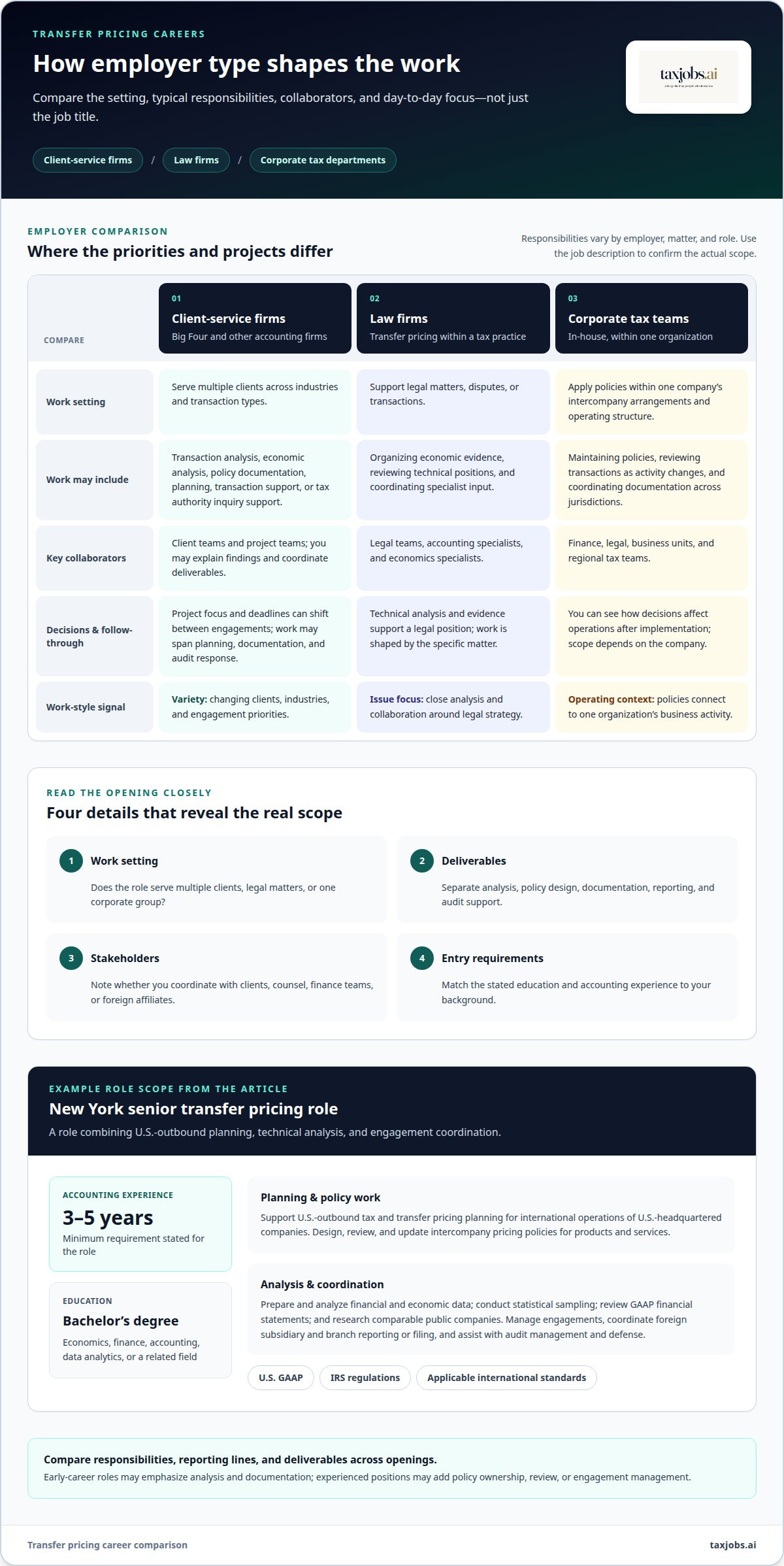
Employer type affects who sets priorities, how projects move forward, and which stakeholders rely on your analysis. Big Four and other professional services firms serve multiple clients. Law firms bring transfer pricing into legal matters, while corporate tax departments apply policies within one organization. These differences shape project variety, technical focus, and how closely you follow decisions after implementation.
Client-service firms
At a Big Four or other accounting firm, you may work across clients, industries, and transaction types. Projects can involve analyzing intercompany transactions, preparing economic analyses, documenting policies, or supporting a tax authority inquiry. The work varies by engagement: some assignments start with planning, while others focus on documentation or audit response. You may also coordinate deliverables, explain findings to client teams, and manage review cycles.
Assess the work mix in the role description. Distinguish recurring documentation from planning, controversy, and transaction support. Consider how analysts contribute to conclusions, how senior staff review work, and how project teams divide responsibilities. These details show whether a role emphasizes independent analysis, client coordination, or both. Client-facing work can build communication skills alongside technical judgment, but priorities and deadlines may shift between engagements.
Law firms and controversy work
In a law firm, transfer pricing may sit within a tax practice and connect with legal analysis, disputes, or transactions. You might support a legal team by organizing economic evidence, reviewing technical positions, or coordinating with accounting and economics specialists. The work depends on the matter and your role. This setting may suit professionals who prefer close analysis of specific issues and collaboration around legal strategy.
Compare the expected contribution with your experience. A controversy-focused role may call for clear documentation and careful evaluation of transaction facts, while a broader tax position may involve coordination across specialists. Look for the stated deliverables and the teams you would work with. Technical analysis can support a legal position; project coordination keeps evidence and specialist input aligned.
Corporate tax departments
An in-house role centers on one company’s intercompany arrangements and operating structure. You may coordinate with finance, legal, business units, and regional tax teams. Work can include maintaining policies, reviewing transactions as business activity changes, and coordinating documentation across jurisdictions. You can see how decisions affect operations after implementation. The role’s scope depends on the company’s structure, transaction profile, and internal tax responsibilities.
For businesses owned or controlled by the same interests, the Secretary may allocate income, deductions, credits, or allowances among them, according to the Legal Information Institute, Cornell Law School. This principle links transaction analysis to the financial results recorded across related entities. In a corporate department, understanding transactions and supporting records helps connect policy decisions with business activity. Coordination with finance and operating teams is part of that work.
Experience and role scope
A New York senior transfer pricing role required a minimum of 3-5 years of accounting experience and a bachelor's degree in economics, finance, accounting, data analytics, or a related field. It supported U.S.-outbound tax and transfer pricing planning for international operations of U.S.-headquartered companies. Responsibilities included designing, reviewing, and updating intercompany pricing policies for products and services.
The role combined analytical work with engagement coordination. Responsibilities included preparing and analyzing financial and economic data, conducting statistical sampling, reviewing GAAP financial statements, and researching comparable public companies. The work also involved managing tax and transfer pricing engagements, coordinating foreign subsidiary and branch reporting or filing, and assisting with audit management and defense. Stated standards included U.S. GAAP, IRS regulations, and applicable international standards.
Use these criteria to assess a specific opening:
- Work setting: Identify whether the role serves multiple clients, legal matters, or one corporate group.
- Deliverables: Distinguish analysis, policy design, documentation, reporting, and audit support.
- Stakeholders: Note whether the role coordinates with clients, counsel, finance teams, or foreign affiliates.
- Entry requirements: Match the stated education and accounting experience to your background.
Titles alone don’t define a role’s scope. Compare responsibilities, reporting lines, and deliverables across openings. An early-career role may emphasize analysis and documentation; an experienced position may add policy ownership, review, or engagement management. Use the stated duties to judge whether a role builds the technical depth and operating exposure you want.
Taxjobs.ai
taxjobs.ai helps you move from comparing employer settings to reviewing live tax opportunities. Its job board tracks and curates roles across specialties, seniority levels, and employer types, including transfer pricing careers. Use the Tax Specialty Job Directory to focus your search, then assess each listing by its responsibilities, employer setting, and stated requirements.
Featured Hand-picked Roles highlight selected opportunities, while Standard Job Postings offer another way to review open positions. These options can help when you know the kind of work you want but are still weighing firms against in-house roles. Recruiters can use the Recruiter Dashboard to manage hiring activity.
Contact taxjobs.ai if you’d like to discuss the platform.
FAQs
How can you compare two transfer pricing job descriptions?
Focus on the role’s responsibilities, the teams it works with, and the decisions it supports. Compare those details instead of relying on matching titles.
Can you move between employer types?
Your experience may transfer across settings if you can show how you analyzed transactions, communicated findings, or supported policy decisions. Describe your experience through those responsibilities, not just the employer context.
What should you prioritize when choosing a role?
Set a clear priority, such as deeper technical analysis, closer involvement in business decisions, or work on legal matters. Then assess whether the role’s stated duties support that direction.